with 🎙️ Jim Lauria – VP Sales & Marketing at Mazzei Injector Company
& with 🎙️ Adam Tank – Director, Software Solutions at Transcend Water


What we covered:
🍏 Why two seasoned water professionals and conference speakers embarked on a podcast journey – and what they aimed to fix in the water industry
🍏 Why many water professionals, industry experts, and… podcasters fail at connecting with their market – and how to fix it
🍏 How partnering with a Behemoth online media helped our Boomer/Millenial duo to take off
🍏 The long-ball game Jim and Adam are playing to move the Water Sector forward
🔥 … and of course, we concluded with the 𝙧𝙖𝙥𝙞𝙙 𝙛𝙞𝙧𝙚 𝙦𝙪𝙚𝙨𝙩𝙞𝙤𝙣𝙨 🔥
Teaser:
Resources:
➡️ Send your warm regards to Jim on LinkedIn
➡️ Get a share of Adam’s wisdom on LinkedIn and another bit on Twitter
➡️ Visit their dedicated Water Online Webpage
➡️ Walk a worthy extra-mile on Adam’s ThinkTank (you may want to subscribe to his newsletter!)
➡️ Learn to love water on Jim’s Website (you may want to read one of his books!)
➡️ Have a look at Transcend’s fascinating attempt at disrupting engineering (or check our dedicated podcast episode)
➡️ Inject some fresh Ideas in your treatment train with Mazzei Injectors (pun intended 😀)
is on Linkedin ➡️
Full Transcript:
These are computer generated, so expect some typos 🙂
Antoine Walter:
Hi, Jim. Hi Adam. Welcome to the show.
Adam Tank:
Excited to be here, Antoine.
Antoine Walter:
It’s the very first time I have two guests. So you have two on one, be kind with me
Adam Tank:
Cage match.
Antoine Walter:
I’ll take the opportunity to have two fellow podcasters on that show. And more to that in a second to start with two postcards, the first postcards comes from Kansas city. So Adam, can you tell us a couple of words about Kansas city?
Adam Tank:
Kansas city is two cities as we were discussing. So Kansas city, Kansas, Kansas city, Missouri split by the Missouri river. I live on the Kansas side. It’s right in the middle of the United States. Quite rural. Most of the economy is based around agriculture or transit transportation. So railroads, big industry here as well. And we’re very famous for barbecue. So way back in the day when the cattle were driven from North to South in the United States or South to North, a lot of them would be slaughtered here or eaten here as part of that cattle driving process and Kansas city is now famous for barbecue.
Antoine Walter:
So from that barbecue, we moved to San Francisco and that’s you Jim. So what would be your couple of words from San Francisco?
Jim Lauria:
Sure, sure. For the Cisco or the city by the Bay, beautiful area to the South where Silicon Valley, as you will know, and then to the North, we have Napa Valley, the wine country, beautiful area to East Lake Tahoe. So surrounded by mountains, lakes, Ocean, just a great area. And then of course, the city of San Francisco, which is a very cosmopolitan city and very well known for its food, its lifestyle, excellent place to be from.
Antoine Walter:
So actually at that place, usually I would ask my guests a bit about their path, but I’d like to take a different twist here. You are running a podcast, both of you together, and your podcast is about water. It’s called water. We’re talking about, but actually it’s not directly about water. It’s about talking about water. So I thought that’s an interesting twist. And then I saw your trailer and your introduction, which was saying that you are the two most. And I quote kick-ass storytellers in the water industry. So lets me play a bit around that. And I have this book, I haven’t read, you have Jim, but I haven’t read it, which is the hero with a thousand faces from Joseph Campbell. But the concept is really cool. It’s about all these stories, this mono meets of the hero’s journey and have been at the movie theater with my daughters, seeing frozen too, which is following that same hero’s journey. And I thought, why not use the hero’s journey to interview the two most kick-ass storytellers in this industry? And we’ll be following the 12 steps of that hero’s journey if that’s okay with you.
Adam Tank:
Sure. Yeah, we love it. That’s a great idea. Yeah.
Download my Latest Book - for Free!
Antoine Walter:
So let’s start with step one. The step one is the ordinary word. So we meet our two heroes and today your heroes are you Jim and you Adam Jim, you’re the VP sales and marketing of the Mazzei injector company. That’s a bit of your background, but it would be cool if you could guide us very quick into your steps.
Jim Lauria:
Sure. So I’ve got a degree in chemical engineering and when I got out of school, I started in the process industries started in the sugar industry as a process engineer, production manager and environmental manager, and then moved into sales and marketing and became an expert brewing and filtration of beer. So I had the engineerable germ of traveling around the world and visiting all the breweries and moved there up in my Korean process. Industry news became a CEO of several companies. And around 20 years ago, I decided to really focus on the water industry and more from the sales and marketing side of the water industry. And one of the things that Adam and I are connected on was the idea about marketing and how to tell stories. We don’t claim to be the most kick-ass storytellers, Antoine wouldn’t claim to know the most kick storytellers. And that’s what really predicated the podcast where we felt between the two of us. We could get some really good people on. And the joke is we want to talk about water. We want to talk about talking about war. So that’s kind of the journey to the podcast and I’ll let Adam fill in some of the other ones.
Antoine Walter:
So if you know the most kick-ass storytellers, I mean, there are many, let’s go a bit outside of the water industry for a second. What would be a couple of names who would give here? What’s your inspiration?
Adam Tank:
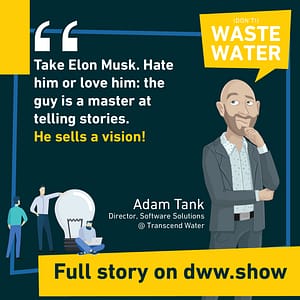
Oh man, there’s so many good ones. I think of people like Malcolm Gladwell. There are a lot of really good authors that do a really nice job of telling stories and they take things that are typically boring or commonplace and they make them very exciting and approachable to a commoner like me. I never want to be business linear, someone like emailing loss, Kate and her love him. The guy’s a master at telling stories. He’s a master at selling a vision about getting to Mars and why anyone would put one of his vehicles, a Tesla and his space. I mean that in and of itself is an incredible story. So I look at people like that and think the outcomes that they’re driving for themselves or their industry are the exact same outcomes that we need to bring more eyeballs into water because that drives more investment. It drives more interest, it drives more talent, it drives more business. It drives everything that when you need to be a successful 21st century industry, which arguably we’re not right now.
Antoine Walter:
Well you are working Adam for a company which aims to change that industry. I was very impressed when I had the chance on that same microphone to interview Ari Raivetz, the CEO of transcend. And I’m still shocked by what you’re building, but for the ones that missed episode 17, can you present you your company and then a bit of your path
Adam Tank:
Be glad to I started out as a microbiologist. It didn’t take me long to figure out I hated that type of work. I hated being in a lab. I didn’t enjoy the quality engineering I was doing in the food industry. And in grad school, I got the opportunity to intern at GE water who has since been sold to Suez. And one of the things I love about this industry is the people, just an unbelievable amount of love and passion for what we do. And it’s very hard to leave once you’re in it. So there were a series of very fortunate events. I ended up with a company called Organica water, which was a small wastewater treatment firm. And the goal was to spin this software out that helped Organica put together bids for wastewater treatment plants without spending hundreds of engineering hours doing it. So they basically automated that conceptual or preliminary design process and the bidding process for wastewater treatment works.
And we’ve done that. We spun the company out now it’s transcend. And I jokingly refer to myself as an engineering therapist most days because many engineers, when they come to grips with the fact that software can actually do quite a bit of what they’ve done for 10, 20, 30, 40 years of their career. Things like playing around in Excel spreadsheets or drafting P and IDs or creating BIM models of buildings. Software is really good at doing that stuff. So I helped them overcome sort of this existential crisis of what happens to my job. If software starts to automate a lot of that boring work that I’m doing, but more broadly Antoine and why we’re happy to be on this podcast. And I’m happy to have you as part of the podcast ecosystem as well. Is that in general in water, we don’t do a good job of selling ourselves to the public, whether you are a utility, if you are a treatment company or a technology company, if you are someone on the regulatory side, it takes catastrophic events like what’s happening in Texas right now to bring water to the forefront of the conversation.
And that shouldn’t be the case. We shouldn’t have to wait for pipes to explode for people to talk about us. We shouldn’t have to wait for situations like Flint, Michigan to happen for people to talk about the need for investment in our sector. It’s just a shame that that’s happening and it doesn’t have to. It’s completely avoidable. And Jim and I believe that it all starts with telling better stories in water,
Download my Latest Book - for Free!
Antoine Walter:
Actually that makes us a very smooth transition for the call to adventure. Because I wanted to ask you what tend to do to start a podcast. But to me, that’s pretty clear you’re on a mission, right?
Jim Lauria:
Yeah. Right. That’s exactly right. Adam and Ryan, we met at a conference when we were both present separately and we just had this connection. And I presented to Adams was around for my presentation. He got what I was saying, same for me and a will shared an Uber to the airport together. And we found that we were both at the time living in San Francisco and we get together on a regular basis and talk about this whole idea of marketing and how it wasn’t being done as we thought it should be. And the idea of the podcast started when, when you want it, first of all, we’re going to do an article together. And then I saw a podcast about doing podcasts and we talked about it and we thought, we’d give it a try. And that intro that you alluded to, that’s pretty much the story of how we actually got to the podcast.
And you know, the joke was, Hey, let’s see who else is out there and who else is doing podcasts? And I put a little mind map together and we saw all the different podcasts, what they were doing well, what they weren’t doing well, we appeared on several of them and that’s what really launched us.
Adam Tank:
The other thing I’ll mention right now that we haven’t talked about was that Jim and I come from very different sort of schools of thought relative to our water industry experience. Jim is, as we, you know, laugh about isn’t boomer, we laugh about me. I’m a millennial. Clearly our generations have very different ways of looking at the world. So part of what we are hoping to do is approach and be approachable for a broader swath of the water industry. Jim was sort of a more old school approach to sales move with the sort of new school approach. And then of course, how we blend the two in order to tell better stories in the sector,
Antoine Walter:
Talking about stories. I’d like to dig in into that in a second, but I have to follow my, my hero’s journey. If the trailer is rights, that means to you, Adam, you were not that convinced about launching a podcast at first, is that right?
Adam Tank:
That’s absolutely true. That’s absolutely true. There are too many of them and they aren’t helpful to the audience. They aren’t valuable to people in water. They just it’s people that they’re talking heads and they don’t really get to any sort of real value for the listener. And we wanted to change that.
Jim Lauria:
Adam was very adamant about the Adam adamant. Hadn’t been there. We had to give actionable results. It wasn’t just to talk about water. It was the storytelling, but it was so that the audience actually got value from what we were saying. And if that’s one, we don’t do much talking on the show like you, I mean, one of the models that we looked at and said, you know, who’s doing what well, and we liked the fact the way you are very well prepared for that podcast, them when you put the graphics together after the podcast. So add a number of podcasts. We appeared on a couple of podcasts, so how we could work together. And that, that was kind of the journey. And of course, you’re going to ask about our relationship with water online. And we’ll get into that a little bit later down the road
Antoine Walter:
Before touching to water online, actually, you know, when I personally started the podcasts, I didn’t know there were so many podcasts, but even when we say so many, if you go to Apple podcasts and you type marketing, it’s not like 10 podcasts, it’s like 10,000. So I guess we are still pretty Greenfield compared to that. So what made you think that it was overcrowded with similar stories?
Adam Tank:
For me, it was that, and maybe it is just our little corner of the internet or corner of the Waterworld, but I felt like a new podcast was popping up every week. And the reason I felt that way was because on LinkedIn, I saw them coming up. I would get emails about new ones. I would see at various conferences, people were launching a new podcast as part of the conference. And at some point it just became overwhelming. What? I don’t have time to listen to it at all. And secondly, the couple of ones that I did listen to provide me no value to me, selfishly, they provided absolutely no value. And so the only way Jim was going to be able to convince me to do this thing was if we could provide actionable takeaways for our audience, where they would at the end of the episode, think, Oh my God, I got to go do that or all, man, I need to go find a way to get budget, to tell better stories.
Antoine Walter:
So actually talking of actionable takeaway, and that’s my smooth transition to the mentor helper, which is here, water online. I don’t know if you know these tool called spark Toro spark to rule gives you an insight into any kind of industry. What are the influencers who are the go-to places and things like that. And you should type water or wastewater into spark Toro. They give you as number one, water online. So you partnered with the number one, go-to the number one place for people to go and seek information in that industry. So here that would be a cool takeaway for me. How do you do that?
Jim Lauria:
Well, I have been writing for water online since about 2007, 2008, and I just connected with them and their audience seem to gravitate to my content. And I’ve been the number one writer on there for a number of years in a row. And the general manager, I knew they had salespeople and I just felt that they were the ones to really see and maybe be the partner with because both of us really felt we couldn’t know who would be the best people to work with.
Antoine Walter:
So you’re the number one writer on the number one platform that makes you our superstar in the industry,
Jim Lauria:
You Adam and I, we both agreed that we weren’t going to be the ones to edit, produce it. We needed to find a good partner. And so that’s how we came to develop our relationship with them to work with us on the podcast.
Download my Latest Book - for Free!
Antoine Walter:
How does it work? You record the podcast, they edit it, they put it on water online and you do your amazing mind map.
Adam Tank:
Yeah, that’s exactly right. So we record and they edit and promote. And then of course we’ll do our own promotions separately as individuals.
Antoine Walter:
Let me go to the transformation step, you record your first podcasts and you didn’t choose like nobody in that industry. You had an awesome first guest. An awesome first story. What was your feeling when you first hit that record button? So finally you’re becoming a podcaster, but were you excited, stressed? What was the feeling there?
Jim Lauria:
Well, we were pretty relaxed because I had a good relationship with Paul O’Callahan and that’s one of the things that we developed was, you know, Adam knows a lot of people in the industry. I know a lot of people in the industry at work with Paul because he told the story with brave blue world. We felt that was a perfect person to start with. And so I want you to notice. But we felt that we had a real good guest and we had really good questions, very well prepared. And so that’s how it ended up being the the, when you looked at having him as our first guest.
Antoine Walter:
So I’d have one for you here Adam. You, you are very active on Twitter, which is shorter form. What does it change to have half an hour, one hour, some podcasts or even five hours? So you have much space to go in depth, which is pretty different. Does that change something or is it really same but different?
Adam Tank:
That’s a great question. I hadn’t thought about it. So you’re going to get my top of mind. Thoughts for me, Twitter forces you to condense the thoughts that you have and provide value in a very short, as you said, short form, even if it’s a tweet thread. So I think I actually bring that to the podcast world rather than the podcast world having influence on my Twitter account. So in this case, all of our episodes are 30 minutes or less. We ask very hard hitting short questions to the guests that are very pointed. We don’t let them get off the hook with talking about in generalities. We want to get into the nuts and bolts and the specifics. And again, it all comes back to how much value can you pack in and whatever amount of time that you have. And I personally feel like I don’t have enough time to listen to podcasts. I think Jim probably feels the same way. So we make sure that the time that we spend in the interviews is direct, condensed. It’s valuable. They are actionable takeaways. We have sound bites that work for our audience. And ultimately I think personally, and I don’t know how Jim feels about this, but we have better conversations because of it in terms of how we prepare, how we prepare our guests how the interviews are laid out. All of that,
Antoine Walter:
Actually, the way you prepare is interesting to me, because for me, it’s very new. I’m talking to two different guys and it’s a different way to conduct the interview, but still I know that all the questions are with me and all the answers are with you, but you are on the other end. You have two people with the questions. Do you share them in advance or do you play good cop, bad cop boomer? Millennial, of course. How do you approach that?
Jim Lauria:
Well, like you said, Antwan, it’s about preparation, creating a mind map for each one of the guests. And we do a run through with the guests beforehand. So we know what exactly we’re going to speak about. And then Adam and I, we just work well together and we don’t step on each other’s toes. And part of the value of Adam and I working together is there’s that little tension, the conflict of, Hey, let’s ask this. Let’s not ask that. I came up with the idea of introducing, I guess, how we’ve learned about their work and how we first got to know them. Adam came up with the idea about the Anthony banner and what you would want to tell water professionals if you have this airplane banner flying around the world. So you know, that creativity with the two of us has really worked well.
Antoine Walter:
And you had M how is it to be the millennial there?
Adam Tank:
Maybe unfortunately, that I’m bald. Maybe I look a little older than I really am. I don’t know. I guess I don’t feel like I’m on a, I’m on a worst foot than if I were a bit older in the industry. I do think I come with a bit of a unique perspective because I see the world becoming much smaller because of the internet. And I see the value of building an online brand because I see it on Instagram or I see it on Twitter or see it on Snapchat, or I see it on clubhouse. So I see all these different platforms and I know the trajectory of where content marketing is going. And Jim, of course, even as a Boomer is extremely on top of where content marketing is going. So in that sense, despite our differences in age, we have that overlap of how valuable we believe good content is and what the water industry can be doing. So like Jim said, we feed off each other very well because we both have the same shared vision in terms of how water brands, water, people, water companies can be more, do more, sell more using online toolkit.
Antoine Walter:
Let’s go to the bottom of that. What annoys you the most with what you see today in the water industry, with what people do with how people communicate with how the marketing is done around our sector? Because you said that was a strong belief at the very beginning to start with that and to say, you met in that plane and you thought there’s something we have to change. So what is this bigger picture you’re aiming at?
Jim Lauria:
Yeah, I think the biggest thing, Antoine is the fact that people think they’re telling the story by given facts and figures, features and benefits about their products. So, you know, they’ll show their pump curves, they’ll show their filtration capabilities and they think they’ll tell him the story. Whereas Adam, and I realize it’s the journey, right? And so you take this journey and you want people to pretty much look at what’s going on as a trend in the water industry. And then at some point you can tell them about your products and services, but it doesn’t start there. It starts with gaining credibility. It starts with understanding the audience that they’re not just interested in, what type of product you have or what type of features and benefits your product mine service might have. It’s about relating to them and understanding that we all have issues in the water industry. And you can get a much broader audience by telling that story early on about trends and market issues.
Download my Latest Book - for Free!
Antoine Walter:
So who’s that audience, who are you aiming at is two water professionals. Is that the general public? What’s your audience? What’s your target audience? What’s your persona to use the big names?
Adam Tank:
We believe it’s the primarily the vendors of water and wastewater technologies and services. And then of course, if we catch anyone else as part of that net, that is great as well. That’s icing on the cake. So when we talk about who is listening to the podcast and why have in my mind, and I think Jim would agree with this, but I’ll be curious to hear what he has to say. It’s a salesperson inside of a, let’s say a pump company who’s out there knocking on doors, who stands up a booth at WEFTEC, who goes to, you know, regional water association meetings that ultimately sell is selling a commodity. And the question that he or she is trying to answer is how do I differentiate myself enough that the customers will trust and respect me as a consultant and as a partner. And then of course, ultimately how I ensure that they buy more of my equipment, that’s who I have in mind
Antoine Walter:
And what would be the first takeaway that they would have if they tell better stories, is it like frameworks that they can apply is it’s inspired by the people you get on the microphone. What do you expect them to take as a primary value out of your, your episodes?
Jim Lauria:
Antwan, tell the story. Don’t just you know, split out data and information, start with, can you here’s the trends are going on in the industry and work your way through case studies and solutions. Don’t start with the solution and, you know, gain people from the idea that you don’t want to just spit out that information. You don’t want to tell a story that people will be engaged with to answer your question again. The other idea is we both believe, I believe that if we don’t get the general public to understand the value of water, then there’s a good chance that they’re not going to get our services and products sold, because it’s all about the value of water. So it all comes down to that
Antoine Walter:
Very good point, the value of water. Do you think that water professionals, I mean water jobs are passion jobs or mission jobs, or is it just a job?
Adam Tank:
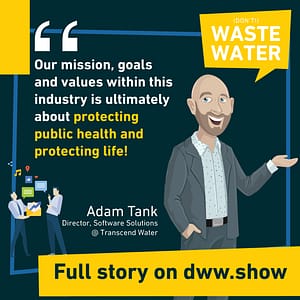
Maybe it’s too optimistic, but I believe they do love their work. Maybe not the day-to-day drudgery. You know, I don’t know that anyone likes to jump into a pit of human waste to have to clean something up if it blows up in a wastewater treatment plant, but the mission and the goals and the values that we have in this industry is ultimately about protecting public health and protecting life. I don’t know any other, any other way to say it. I mean, water is life and without clean, safe, secure, and reliable drinking water, and without a system to collect the wastewater, that’s created either municipal or industrial. The world goes to hell really, really quickly. And I think that everyone in this industry understands that, and that’s why they do their jobs. They do. And wake up every day.
Jim Lauria:
And also telling a story about the fact that water is our food. Water is our energy water is our recreation. All the ways water is linked to everything. We do everything. It’s not just the drinking water that comes out of the tap. It’s everything that we look at around the daily lives.
Antoine Walter:
I’ll tell you why I’m asking that fully agree with you fully subscribe to what you just said. And I see water myself that way and to speak a bit about myself, which I usually don’t do, but my parents met in a water treatment school. So I’m, I’m a son.
Jim Lauria:
Yeah.
Antoine Walter:
But when I was coming from is if you look to LinkedIn, for instance, and you look to human resources professionals, they’re certainly very good HR people. I’m really not judging the full profession, but most of them have understood the strength of storytelling, but they just apply storytelling as a recipe. So you use Aida attention, interest, desire, action, or you use you know, the Christmas TV movie receipt boys. One girl, boy gets girl, boy loses, girl, and boy gets, goes bark. It works. It works, but there’s no authenticity inside. And that’s why I was asking if, you know, if all the water professionals start telling stories, but they don’t believe in the stories, then I’m not sure we made a positive impact on this industry. I don’t know if you get my rambling, but
Jim Lauria:
No, no, no. I totally understand. But I think that’s one of the good things about the water industry Antwan is that I think people don’t just come into it just to be one Memorial industry. I think it’s a passion and I think most people have a passion. And I think that’s what Adam and I want to do. We want to take the people, the war professionals in the water industry and take that passion and use it to tell stories so that the general public can understand it better and they can make more money from it because they have to do it the right way to do marketing the right way that convinces people, that they understand their audiences needs and requests.
Antoine Walter:
Actually, you talk about making money and I saw you. I had them sharing yesterday. We are the, at the end of February when we record this if you’re listening that in the future, but Innovyze just got sold to Autodesk and I loved your analysis of telling the story of that and what it means for the water industry. Can you maybe just synthetize what you were sharing at them?
Adam Tank:
I’d love to it’s it all goes back to the fact that water, in my opinion, is underappreciated and undervalued. And when a company like Autodesk, lays down a billion dollars of cash to buy a, a very niche, very unique software solution. That’s specific to the water industry is a massive signal to the water industry, but then also just the broader market that water is a growth business. Water needs more digital solutions. Water is of utmost importance to companies who are literally in charge of the tool set for creating critical infrastructure. That’s the type of messaging that is so important for our industry. And that post surprisingly is getting a ton of love. It’s getting a ton of tons of shares. I mean, I’ve probably shared a less than 24 hours ago. It was probably 10,000 views on it at this point. And I think it’s because people in the industry and why our industry, and we’re not seeing, we’re not seeing in the point of the guy, it’s not often that you hear the praises of your local water utility. So when there’s a great story about the industry and a great, you know, something to rally around, people celebrate it. And that’s what we’re seeing with that announcement. Exactly. Because you turned
Antoine Walter:
It in into a story, it could be just dry facts, 1 billion, cool, Autodesk puts 1 billion on the table, next story. But you explained it. And I think that’s why you get the love because yeah, at the end of the day, I agree with you. It’s a passion industry. And if you see that finally, there’s an interest of the general public when there’s something positive happening in that industry. And not as you said in the beginning, just because there’s a Flint event ongoing, or just because Veolia tries to buy Suez. It’s interesting to see that this new eye on this industry brings us a bit more in the spots. Maybe we are a bit more proud as water professionals to be water professionals.
Jim Lauria:
And yesterday I was taking a gallery walk and I happened upon a team of San Francisco water department workers repairing a broken water line. I took a photo, I posted it on LinkedIn. I picked this idea for Adam and didn’t get the rug that Adam’s post got quite a few likes and comments. So people can do a lot with small little posts on LinkedIn Twitter to really show that there’s a a need for infrastructure, a need for investment in the water space.
Download my Latest Book - for Free!
Antoine Walter:
That brings me to the key performance indicators for your podcast venture. How can you tell that you achieved it, that you, you reach your goal? Is it likes on, on LinkedIn? Is it listeners on, on Apple podcasts or Spotify, or is it a change in the word
Jim Lauria:
I’ll tell you it’s subjectively what you’ve already found was that Paul O’Callahan contacted Adam and I for introduction to George Hawkins, our second guest, and they’re working on a project together. So for us to have our first guest asked for an introduction to our second guest and they’re working together, I think that’s showing them that there’s a bit of influence going on.
Adam Tank:
What our episode with Megan Glover, the CEO of one 20 water. I posted a a minute clip of one of our interviews where she’s showing off these really cool drinking water plant Lego kits that her company had made. And there’s probably no less than a dozen comments on that post about where can I buy one of these kits because my community needs these or my children need these or my child’s school needs these because we want to showcase what water is all about to a younger generation of people that is priceless. I don’t care how many downloads the podcast gets. If you can get a couple of dozen kits into the hands of children and those kids go on to support the water industry or become water professionals themselves, that’s a win. That’s a big
Antoine Walter:
Actually, that’s something where there’s maybe a cultural gap here between you and me in France, at least when you’re at school. So I’m really before 12, I would say the thing you visit the most is the waste water treatment plants. There’s always once a year, a visit to the waste water treatment plants. So it’s not a matter of awareness which is missing. It’s rather a matter of coming back to what you say, telling a story, because these young children come to the waste water treatment plants. They see, okay, it smells and there’s a pump doing something. And someone explains that you know, there is so much water flowing and at the end of the day, so much goes out to in the river. And so much goes out as biogas. And it’s boring as a child, it’s really boring. So it’s not a matter of awareness that there’s something out there. It’s a matter of telling the story and why that matters. That is not magical, that things flush and disappear. So is it that different in the States? That’s if you don’t put the spots with the Lego kidt on on the water industry, then, then children will never know about it.
Adam Tank:
I have never heard of a field trip to a water wastewater treatment plant in the United States, certainly in kindergarten, or maybe later in primary school, you’re going to learn about the water cycle. And there’s going to be some, you know, educational sessions for maybe a few days or a week about what water is all about. But I certainly have never heard of anyone going to an actual facility in the real world to learn about it. So Megan, you know, those kits, I mean, that’s, you know, kids learn through play and learn through having fun. So in many ways that the Lego kit is a story in and of itself while the child is building it. It’s another way to learn about something that they don’t have exposure to. Otherwise,
Jim Lauria:
I think start with, if people are starting to some of their utilities are doing some outreach, I know the inch to roll a gauge to do all. They’ve done a lot of good work around bringing people into the plants and letting them know what’s going on. But I think it’s still early stage Antwan when I was a child. And Adam seems not to have done it, you know, as a millennial. So, but I think it’s changing. I think people recognize that we need to tell the story of the value of water and more and more people recognize that it should start earlier rather than later with the children in elementary school.
Antoine Walter:
Or maybe it’s me being a water kid, maybe I’m wrong. No, but you know, you, you touch something with this w this LIGO really, which is our industry is sometimes complicated. I give you an example that you might know Jim, I was working for Suez and especially for Ozohnia insights, you as, and when I was talking with my American colleagues, they told me that they always use mezze injectors. And I’ve to be honest, no clue how one of these injectors work. So to me, it’s something I never touched. I never played with. So it’s hard for me to get them the substantial understanding and bottom of it. Whereas if you can have everything in LIGO or in pieces of paper and play around with it, then you get to understand it. And at the end of the day, our industry is not rocket science. It’s sturdy concepts that you have to, to get once, and then you understand them forever. So that really brings it. It’s a bit like what I do is doing with these and thinking it’s really fast prototyping cardboards playing with games. And then you will, you understand what the things are all about,
Jim Lauria:
Right? Well actually at Mazzei, I found out the same thing was happening. People do understand how they work. So I went out and I found a, an animator who had worked on moves, like back to the future and some of the other big Hollywood productions and ended up doing affirmations for the way our injectors work, the way our pipeline flash reactors work or based, and nozzle manifolds, so that people can see exactly what’s going on inside being injector and how it’s mixing the ozone with with the water.
Antoine Walter:
So let me ask you a last question in this deep dive, and then I promise you that I’m cautious of your time as well. What’s your long, long ball game. What do you aim with? I mean, is it like you guess number one was talking with guests, number two, when might do a project then probably guest number three is going to talk with guest number four and do a project by guest number 10. You’re on Netflix, yourself and by guests, number 20, you are at Cannes for the festival.
How do you measure that you’ve achieved something and when do you expect that to be easy question, right.
Adam Tank:
He’s got the, I think he’s got the vision. He’s had this podcast vision since day one. So I want him to take this first.
Jim Lauria:
Thanks. I, the general manager of war online yesterday for about an hour, and we’ll talk to exactly about this, where we’re going, what they think is success. What we think is success. We’ve had some guests on a woman are things that I think we’re doing today. And it’s one is to get people to understand that podcasts can be valuable and it can Sporn some other people doing podcasts that all the better, you know, so telling what a story is, is what we want to do. And that’s the challenge we have. That’s the vision we have. That’s the passion we have. And Adam Rauner talking about a book based on what we’ve learned from our guests were thinking about that that’d be a success.
So there’s a lot of things that we think that can come from this on a partner’s very supportive one on mine. I think George Fisher is a, a client of one online. So we’ll definitely talk about having this podcast that promotes the waterline podcast. What are we talking about on water online’s site? So those are some of the things I see in the medium term future. And you had M what’s your take it’s, it’s largely the same. I want to find a way be it Booker otherwise to scale the lessons we’re learning from our guests to the broader water audience. So we’ll see what that looks like. I think a book is going to be the sort of the quickest path there. And then who knows where that’ll take us afterwards. Then one of the things too, you’re [inaudible] of the podcast is not only to an audience, but I think Adam and I both have learned. And I know for a fact, this is true of me that I’ve picked up some really good tips from Paul, from George, from Megan as waters that I’ve implemented at Mason. And so the value is to our audience, but it’s also to us, you know, we’re talking to the most kick storytellers and marketers in industry. If we don’t learn something from it, shame on us.
Antoine Walter:
Well, actually, yeah, I fully subscribed to that. I have to say since personally launched that podcast, it’s my personal MBA. You’re talking with interesting people that’s spend one hour with you. And if you don’t extract something yourself, then don’t publish it. If there’s nothing for me, then there’s nothing for the listeners.
Adam Tank:
That’s a great point. That’s a very good point. Yes.
Antoine Walter:
So as it promised to not be too French in two a and two don’t steal too much of your time, I produced the switch to the rapid fire questions. Let’s do it.
Download my Latest Book - for Free!
Rapid fire questions.
Antoine Walter:
I’ll let you decide how you want to do that. If you want to take each of the questions the two of you, or if you take the one that has the best to reach timer really up to you. My first question is what’s the most exciting project you’ve been working on and why
Jim Lauria:
So? Well, I’ll take that off first. One of the things I picked up from making Glover was the whole idea of a deep dive into data. And we forget as companies that a lot of the data that we need to tell a story or marketing story resides within our walls, whether Mr Hall’s CRM system, it’s an all project folders, it’s, you know, a CFD model files. So we even bought that amazing on a six month journey that we’re almost completed of doing exactly that, pulling out all the data on our ozone applications and putting that together and within the next week or so, I’m about to run an article called deep dive into data, reveals powerful ozone story about this journey and about how we learn from it about our own product line. We were just accepted into the United utilities innovation lab. So getting a chance to work directly with asset owners on helping them automate the analysis of sustainable design for wastewater treatment plants. That’s what we’re excited about.
Antoine Walter:
It’s a cool one. So what’s your favorite part of your current job?
Adam Tank:
I love talking to engineers despite how challenging they can be on occasion. It comes to talking about various parts of automation relative to their job and their day to day, but they aren’t some of the smartest, most interesting people in this industry. And they’re ultimately the ones that are in charge of developing and deploying the solutions that fix our infrastructure. I just, I love getting their take on the world and seeing it through their eyes because it’s not one that we hear about very often.
Jim Lauria:
And what do I want if I was to run at one, I love to tell stories and kind of coming at it from like an odd different angle of water to just pick up some movie or music or something that people wouldn’t necessarily feel was related to water, but, you know, try and find that connection that can engage people outside of the water industry, that they just see water in a different light.
Antoine Walter:
I’d take a last rapid fire question. What is the trend to watch in the water industry?
Jim Lauria:
So what am I doing? Trends is the use of ozone. And I think it’s a trend that we’re seeing as you can look at it for as a replacement or adjunct to reverse osmosis and over technologies that are being currently used either for disinfection or a breakdown of organics contaminants of emerging concern and so on. So I’m looking at that as a, as a really big opportunity for Mazzei and for the water industry in general,
Adam Tank:
I would say more transparency around water data in terms of usage, in terms of emerging contaminants in term, in terms of the carbon footprint or energy footprint for water infrastructure. I think we’re going to see a lot of regulators require it, and then we’re going to see a lot of utilities start to adopt it.
Download my Latest Book - for Free!
Antoine Walter:
So I’m going to go a bit off script with one last question for you, Adam, and one for you, Jim, two different ones for you, Adam. When we were just discussing before hitting the record button, I just noticed your immense bookshelf just behind you. What is your number one book you would advise us to read?
Adam Tank:
My favorite of all time is a book called think and grow rich was written right around depression era in the United States. So late twenties, early thirties, and it completely changed my outlook on life and what success means and how to go about achieving success. So if anyone listening to this is struggling on, you know, reasonably what is life and what are we going to do about it? I recommend reading that book who was the altar, the Polaroid Hill. It was very influential to me as well.
Antoine Walter:
Well, okay. So I should definitely read that one apparently. So let me put that on my list. And my last question for you, Jim, is you don’t have the chance to, to have a full episode about transcend. And I shortly mentioned that I was six years in the, in the ozone game. So I would be really interested, especially the, now that you mentioned that it was on is a trend for the future. If you would do me, the owner of making a deep dive with me on that, on that topic in a future episode.
Jim Lauria:
Absolutely. Absolutely. I I’d love to speak about it. And it’s when it’s an interesting topic and, you know, stay tuned for what we publish next week, because I think it’s going to be really interesting for the Wardman industry in general and for the ozone industry as well.
Antoine Walter:
Just give me a spoiler.
Jim Lauria:
Okay. So basically there’s a lot of different ways of putting ozone into the war. There’s find whole diffusers, which have been used to put ozone in the forties. And he came up with some interesting technology around our injection technology. Our injectors are Venturi injectors and pipeline flash reactors, and we think it’s a much more efficient way, a much better way to reduce bromate formation. So it’s a trend that’s going to change things on, more efficient about using ozone for treating drinking water and wastewater.
Antoine Walter:
Okay. I don’t ask you directly a thousand questions I have right now, because if I do, so I’m going to sidetrack you for one more hour. Let’s spend that one more hour in a separate episode, but really that’s a fascinating topic and I’m sure we have much to extended on that. Well, thank you to both of you for your time. I’m sorry. I was, I was French, so I took a bit more, but you know, eh, that’s your fault if you would have been boring. So thanks a lot and see you sooner on the podcast.
Other Episodes: