with 🎙️ Denise E Mall, Managing Director of EnsO Earth


This episode is part of my series on Nature-Based Solutions (check it out 😉)
What we covered:
🍏 How we can learn from nature and apply the best of what it developed through 3.8 million years of R&D
🍏 What Biomimicry is all about, and how down that path you’ll find Net Positive Water
🍏 How EnsO Earth created the Living Machine and the Living Building concepts
🍏 How Janine Benyus ignited the “sacred fire” that steers Denise towards creating a better planet for her great-great children
🍏 How becoming an Engineer as a woman is still not as much of a common path than being a teacher, a lawyer or a nurse
🍏 How most of the pollution can be traced back to humans, pouring chemistry into nature
🍏 How there is no such thing as “waste” in nature, but only valuable building blocks and natural resources.
🍏 How we’re kind of stupidly using drinking water for water applications that don’t require at all such a level of purity
🍏 How it is our collective responsibility to sort the mess we’ve created
🍏 How “Day Zero” may sadly become much more common all around the Planet
🍏 How transposing the International Space Station’s water management to earth is only a matter of financial equation – and how we value water stress.
🍏 Biophilic environmental connection, the power of plants, all being organs of a bigger body, working on reality, not fiction, and much more!
🔥 … and of course, we concluded with the 𝙧𝙖𝙥𝙞𝙙 𝙛𝙞𝙧𝙚 𝙦𝙪𝙚𝙨𝙩𝙞𝙤𝙣𝙨 🔥
Resources:
➡️ Send your warm regards to Denise on LinkedIn
🔗 Check EnsO Earth’s website
is on Linkedin ➡️
Infographic: Biomimicry
Table of contents
- What we covered:
- Resources:
- Infographic: Biomimicry
- Full Transcript:
- Becoming a Water Professional
- Biomimicry as a Career Turning Point
- What is Biomimicry?
- Leveraging Ecological Design Thinking
- Is Biomimicry a Silver Bullet?
- We are the problem we have to solve
- Biomimicry applied: The Living Machine Project
- There is no “Waste” in Nature!
- Biomimicry Level 2: Net Positive Water
- Let’s define Net Positive Water
- Can the International Space Station’s Water Management serve as an example?
- How to break the Water Silo?
- How to break the patterns, in a specialized society?
- What’s the role of EnsO Earth in this transformation?
- How to measure success when you’re an advocate of Ecological Design Thinking, Biomimicry and Regenerative Solutions?
- Corporate Social Responsibility, ESG, Impact
- Is the “New Normal” an Opportunity?
- Rapid fire questions:
- So my first question is what is the most exciting project you’ve been working on, and why?
- What’s your favorite part of your current job?
- What is the trend to watch out for in the water industry?
- What is the thing you care about the most when you’re working on a new project and what is the one you care about the least?
- Do you have sources to recommend, to keep up with the water and wastewater market trends?
- Would you have someone who would be nearly as passionate as you and that you would recommend me to invite on that microphone?
- Other Episodes:
Full Transcript:
These are computer-generated, so expect some typos 🙂
Antoine Walter: Hi, Denise. Welcome to the show.
Denise Mall: Hi, Antoine
Antoine Walter: I’m very glad to have you. We’ve been discussing that for a while now. We will be touching on a very fascinating subject in just a minute, but right before we start, can you send me a postcard can you just tell me where you are and what I should know about the place where you are?
Denise Mall: Okay. So technically I am in the center of South Africa, based in Bloemfontein right now, which is in the free state.
I’ve landed there because my mom got ill and she was visiting my brother and he lived in Bloemfontein so we decided to come over.
I’m quite mobile and can travel. I’d love to be doing international travel rather, but it’s proving to be quite interesting actually.
Becoming a Water Professional
Antoine Walter: we are going to be talking about water today quite a lot. And I’d like to understand how you got first interested in that field of water. What brought you to that?
Denise Mall: I think we have to kind of start with, how I ended up in engineering. I think that’s really where it starts because it’s not really something most people end up in and being in the industry for 35 years now. , that means I went into the industry way back in the mid-eighties. So yeah, I landed in engineering by mistake.
So what happened was I was in high school, final year and the company approached the school for a drafting position. They were looking for a young girl to train in drafting. And I think like figuring out if I wanted to be an architect and maybe even like, thought about the reality that.
Engineering as a Woman is still a long shot
Drafting isn’t just architecture. So no Google, no background research. So the sad part of that story is that in high school, we were never, thinking to work in engineering. Cause like you had to become a teacher, a doctor, lawyer. I literally stumbled into it. but They offered me the job and that’s my baptism, into engineering. I started drafting water in that’d be water resources, amazing stuff.
And within six months offered to boost me to go and study, and that was my journey into engineering.
So long story short. I think we are all connected to water subconsciously or consciously. It is part of what we are. Looking back through my career now, I don’t know how it was ever going to be anything else, you know, but it has evolved. I was apparently the first woman in the company to ever be boosted for engineering.
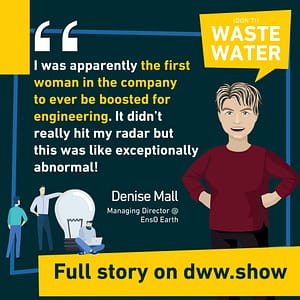
I mean, it didn’t really hit my radar, but this was like exceptionally abnormal. And I couldn’t figure out why they made me jump through all these hoops two days or second metric testing. Lots of questions about what is my long-term plan. What happens if I become a mother and I’m not even thinking about that, I just want the job.
And I just want to study and this looks really interesting.
Biomimicry as a Career Turning Point
Antoine Walter: You just cracked a major spoiler about the next step of our discussions. But right before jumping, into this way that nature can, itself solve the water issue and how nature can treat water.
What I would be interested to understand in your path is how you switch from being on the traditional side of the water sector – this engineering path and all these elements – to a non-governmental organization with EnsO Earth today. So how does that happen?
Denise Mall: I’ve always followed my gut instinct and that’s the things you do, I think it was my destiny to be working here. And there’ve been a lot of small incremental steps that kind of bring you to where you are.
And then when you look back through your life that you join all the dots, you know, the pivotal point came in about, 2008. I’ve moved to the Western Cape from Johannesburg.
Meeting the Grandmother of Biomimicry
And I was trying to. Figure out life. I was on the path of trying to understand sustainability and the Cambridge Institute or sustainability actually brought up Janine Benyus to Cape town, to present live.
And if anybody in this industry understands biomimicry she’s like the grandmother of biomimicry, she coined the phrase, she defined the principles, to be able to see Janine Benyus live was an opportunity that far exceeded my comprehension back then, because she was relatively new I remember walking out of that presentation.
How did we get this so wrong? It was mind-blowing when you finally realize that all the answers are there, we already know what we need to know. We just need to unlock it. That was the pivotal point because he was coming out of that presentation that I pivoted my company from doing industrial and mining projects.
Pivoting a company to have an Impact
That’s was that 2010 and starting off pivot towards green, a project, looking at green alternative energy projects are being like a wind farm. And then it’s no plant and OPG plants. And then about 2012, I heard about this thing called social entrepreneurship and I’m going, oh, that sounds interesting.
So basically that is how can you do good and make money? Well, I could do that. Really the focus thing was how do I promote biomimicry within South Africa?
It’s evolved into creating the biomimicry, foundation in 2018 with some fellow colleagues. And then also realizing that there was a whole lot more to this than just biomimicry.
Beyond the concept of Biomimicry
I was battling to make that hard connection between biomimicry and infrastructure design because nobody has joined these dots. So if I’m starting and teaching or promoting biomimicry, but still not being able to connect it back to the engineering industry, which is where I really felt it needed to happen,
And It became more about why I originally wanted to start the foundation, which was all about how do I ensure that my great-grandchildren will have a planet. But it kind of goes back to the original 2009 meeting where I found Janine Benyus. The fact that we could go beyond sustainable to regenerative design.
It is about Saving Ourselves!
And the reason we want to do that is that we need to ensure our longevity as humanity on this planet. And that’s, I think that’s when the penny first dropped, but if we don’t fix it, there isn’t a future generation.
We find ourselves when we find ourselves and when things present. You have the choice to grab onto it or just ignore it. And this was a situation. I found myself at a position in my career where I didn’t like what I was doing to the planet.
I realized, the impact of those actions. And I was really basically finding the last sentence or the death sentence of my future offspring, if I’ve been, do something to change it. And that’s what the formation or the foundation is.
What is Biomimicry?
Antoine Walter: Before zeroing down, on the net positive water, you’ve used a lot, the term biomimicry, which we’ve heard already on that microphone a bit when I was discussing with Michael Stanley Gallisdorfer, but let’s define it, for everyone to grasp what the concept is, what would be your take at the definition of biomimicry?
Denise Mall: Basically nature has spent 3.8 billion years doing the R&D that is required to produce life. All we have to do is learn from nature. So we spend all of our energy teaching people about nature instead of learning from nature.
The three levels of Biomimicry
And then the next level is what does nature teach us? And there are basically three levels that we can learn from these. Imitate nature’s forms. So that’s your shape and your, your structural spider of nature. Well, we can learn her recipes, which are your processes. So this is the chemistry of nature we can monitor systems.
Which is really the systems within the system or the processes within the systems, but the most powerful design of a one incorporates all three levels. So where you design in the context of Biomimicry, you looking at nature’s foods, you look at nature’s recipes, you’re looking at nature’s systems and you’re weeding that into the solution.
That’s in a nutshell is biomimicry. And basically, it’s a perfect gateway into this realm of regenerative design or systems thinking and design thinking
Leveraging Ecological Design Thinking
Antoine Walter: I love that concept. Actually. It is your tagline on a website, this ecological design thinking. just incredible. If I get it right, when you do this empathy, the first phase of design thinking, usually you go to your users and you watch them evolve and you look at what they do, and you try to understand the challenge and then come with solutions.
And if I get you right here, it’s you go to nature and you try to get from nature. What’s happening right there. And what can we replicate? Is that a right encapsulation of your concept of this ecological design thinking?
Denise Mall: That’s exactly it. So what, what do you do when you’re looking at applying biomimicry is basically you look at the boob and you go, what are we trying to do? So in other words, we’re trying to purify water. What would nature do to purify water? And, and the biomimicry Institute has got this amazing stack called ask nature.
But you basically just type in what you’re trying to achieve and they catalog all the potential solutions that relate to what you’re trying to do. That’s really been hard because of all the donkey work, you know, and the leg work to create the system and the platform that helps us design, in alignment with what nature would do.
Biomimicry, Circular & Donut Economy…
Living future, biomimicry, circular economy, Donut economy, they are all fundamentally the same because it’s all been based fundamentally on nature.
So nature solutions and the realization that nature designs, cyclicly or circularly. So there’s, the start there’s a boost. There’s a growth, there’s a maturation, there’s aging, and then there’s a dying. And then there’s a reboot that is the design of nature and the byproducts are always the starting point for new life. And that is also the essence of circularity and circular economy.
Antoine Walter: When it comes to water and wastewater treatment or remediation, whatever we call it, is it a silver bullet? Can you take like designed by nature? Copy what nature would do and can we really solve for everything that we are putting into this water? Because some of it is, of course, I mean, there’s nothing on this earth, which has no link at all with water, but some of the components we’re putting in there are really so heavily transformed that they are barely still natural.
Is Biomimicry a Silver Bullet?
So biomimicry as itself. Can it solve for every kind of pollution we’re putting into the water?
Denise Mall: Let’s just backtrack a bit here quickly. I want to define the water cycle. Okay. Because we both know that water is a finite resource. It’s just because nature does the process or the system, so well, that it creates this. The illusion of infinity, but the reality is that there’s no more water today on the planet than there was 4 billion years ago in various forms, like evaporation, whatever it is it’s a finite resource.
It’s the illusion of infinity that nature creates, fundamentally, we all drinking recycled, dinosaur pee.
Antoine Walter: I love that one.
Denise Mall: No way around it. Knock you back when you frame it in that context. When you think that all the water, we consume all the water that comes through the system, fundamentally is the same water that was on the planet 4 billion years ago, 3.8 billion years ago, the same water that the dinosaurs drank and peed.
Download my Latest Book - for Free!

Understanding the Water Cycle…
It’s the same water. It’s nature. that he’s doing what it does really, really well to create that illusion of infinity. Just the same water going through the system time and time again. So what we need to be doing is replicating that.
And the problem with what we’re doing in the modern systems is that we’re giving nature fundamentally, stuff that it doesn’t recognize and identifies. So the minute we put chemicals into the system, that nature does not respond to or know what to do with it fundamentally becomes waste. And our problem isn’t so much how well is this?
How do we proceed? Okay. It’s the fact that we’re not processing the way nature can handle it. So, so when you break it down, when you realize that. Most of the pollution is us giving nature chemistry. She doesn’t, identify and therefore doesn’t know what to do with, or are we giving it to her in volumes or quantities that she cannot manage or break down in the process or the timeframe that she requires to do the process?
… to stop sabotaging it!
Okay. Or we’re working against the natural processes and sabotaging her ingenious designs of purifying air and water by putting stuff into the system that disrupts it. So like for example, deforestation in favor of monoculture agriculture. That disrupts the purification of the air pushing what’s there, but back into the atmosphere, creating rates.
And it’s when you start to truly understand the natural cycles that you can start to identify on the system, the systems design, or the regenerative thinking where you can start to identify where the intersection points need to be to fix the system.
Basically, when you look at the planet in the context of a planet, it’s one very funny chain ecosystem that operates as a whole, I think shows our ability as human beings to live on it.
When we start to disrupt it, we create pollution, we create waste, we create contamination. We create all of our products, which are complete by-products of man’s inability fundamentally to design in accordance with nature
We are the problem we have to solve
Antoine Walter: so what you say is that if we rush forward, because, at one end of the cycle, we are disrupting something that means that at the other end of the cycle, we have to solve for that something and by being more intensive, heavier on the treatments and, and if you keep pushing on both ends. Well, it’s never-ending at some point. It’s going to be so heavily disrupted.
Denise Mall: That’s exactly what’s happened. That is, that is our climate reality. We have pushed all the natural boundaries to the point of breaking, you know, and, most of us, I think, I don’t think we intentionally set out to do that Antoine. I think we did it as ignorance. You know, we thought we are clever.
But we weren’t that clever. you know, and we’re now realizing, that the answer is actually quite simple, we just have to go back to how nature does it, and then boom. Into what we’re doing now.
Biomimicry is all around us
The irony is that we’ve been doing this intuitively for the poor while already without realizing it, you know, like I said to you earlier on and leading to this robotic defined mimicry, we were mimicking the way the body naturally lives, know, internet of things. Its feedback loops in, in systems it’s leveraging the technology to create, digital twins at some level are trying to mimic, and control nature.
Even blockchain is at some base level biomimicry, There’s so much technology that’s coming forward that has not evolved out of people going to look at nature for the solutions. And that’s, what’s actually aiding us to, start correcting the problems.
And one of them in the chemical and water and wastewater treatment is the realization that they don’t need chemicals.
Biomimicry applied: The Living Machine Project
Antoine Walter: Let’s take an example of that. Can you guide us through your living machine project so that we see how that works when it’s applied in the real world?
Denise Mall: The living machine was really just one small element or that same net positive water. Cause it really just feels this wastewater treatment. So the living machine is using nature to purify water wastewater.
You’ve got your anaerobic, your aerobic, and then like your filtration and polishing, and those happen at different stages in the system stuff. In the end, the aerobic level, you’ve got the biodigester and yes, biomimicry again the biodigester mimics the stomach and the way we digest our food.
And really the byproduct of that is the methane gas, which is then harvested for the cooking. But this again is also a great area within the different categories or peak people’s framing of the context. Cause in living future, we’re not allowed to use gas in any form for cooking. Okay. And then we’ve got your aerobic process, which is the classic cells.
And these are already a series of separate cells. I see different things, you know, one is for aeration. The other ones are for filtration and, and you’ll actually see the water quality improving as you take samples from those to settle.
Biomimicry continues outside of the building!
And then we basically go into the constructed wetlands, which is really where the filtration and polishes happen on that large surface areas. Where a lot of the microbial activity takes place.
The bacterial, and this is the reality is that there are always microbes and organisms that naturally feed on the, like in the anaerobic processes, a whole lot of microorganisms that literally feed on, I think it’s nitrates and the phosphates and stuff like that to create what it needs to do for the next stage.
At the end of it, you end up with really purified water to the quality that can be naturally discharged into a river course or watercourse, according to the regulations and the bylaws and the requirements from the government on water quality. So all you can literally direct it into hydroponic, farming, aquaponics, conventional farming.
There is no “Waste” in Nature!
So that’s the reality of that. But in principle, it’s really taking the natural life cycle of water from where it lands get contaminates. And this is what fuels the disconnect. We think we’re the only people contaminating you know look around. There are lots of animals living there. and they are all pooing and weeing and we don’t smell like HESTA Ridge farm. Do we? And I’m like, yeah we don’t.
Nature just does what it does and nobody thinks about it, you know, but we, we actually messed it up when we put water with the mix, you understand?
So when you actually get into the way nature manages waste, it actually does separate the liquids and the solids, even in our own body, the design is separating liquids from solids, but we waste and did as engineers. We’ll just throw the whole lot together and add water we actually created a problem
This is a colorful conversation!
Download my Latest Book - for Free!
Biomimicry Level 2: Net Positive Water
Antoine Walter: I’m pretty sure nature doesn’t call it a waste. It’s just a part of the cycle. And we humans call it a waste. And if you call it a waste and you have to treat it as a waste and you have to just sort it out, but if you don’t consider it a waste and if you say it’s a resource, like another, is that what leads you to this concept of net positive water?
Denise Mall: That’s exactly it. That’s exactly what it is Antoine., It is the realization that waste does not exist in nature. There is nothing called waste in nature, everything is a valuable building block, a natural resource. that is part of I think, net positive water. It’s not the whole of net positive water cause wastewater treatment, only a sector because what net positive water is trying to do is mimic the natural water cycle.
Net Positive Water: A concept all along the Water Cycle
It starts with rainwater harvesting, it looks at the water management, it looks at wastewater management, and then it looks at it from an integration of the whole, how do they cross over and how do they influence each other?
Because how we design is that when you go to cancel for submission, you will do your, um, growth and wastewater submission together. And then you’ll do sewage and water submission together. But the truth is that the two systems influence each other because when you’re looking at.
How your rainwater harvesting, diminishes your stormwater flow and redirects it into another system and then takes your wastewater and reclaims it to reduce your water demand. That’s what we call the ecological water balance. When you look at it within the context of the whole that’s net positive water, because now you’re having to manage the entire cycle, of water from rain, water, or potable water, wastewater, stormwater within the context of the site.
The first fundamental is always in the context of place. Because your soil type, your topography, your climate, all of these things will influence what’s your final net positive water balance look like. You want to be able to keep this close to what the preconditions were to happen, the environmental impact.
Let’s define Net Positive Water
Antoine Walter: That’s the part which I don’t get because to me, the natural water cycle is fully neutral. You have water, as you said, which is still the same. Then we had millions of years ago and what the dinosaurs had and everything. So, That to me is all neutral. So how do you make it positive?
Denise Mall: How they define it in the industry, okay. Is basically net-zero is the equal sign. So your water consumed is equal to your water reclaimed. Which is 50%. . With the net. Positive is the greater than, and others, your water recycled is greater than the water consumed.
So anything greater than 50% is considered positive. And how it’s defined is, for example, when you look at your water balance, your personal water consumption is only 30% and your wastewater reclamation is 60 or 70%. Then in principle, you’ve got net positive according to the definition, but you’re absolutely correct that because it’s a finite element or resource, technically you can never get positive because you can never create water.
The water cycle, from a net positive water standpoint
You can never reduce water. It’s really how they define the positive is a boss, how much he’s reclaimed and what percentage of what is going in is actually reclaimed recycled. reused et cetera, et cetera.
Like I can do an entire podcast on literally net, positive water design because it’s fascinating because that was the pivotal point in my career.
And it only happened like a few years ago when I realized there’s actually a different way to do this because we have been. So indoctrinated and taught to follow the design codes and never question let’s see, talk with, when you start to break it down and I don’t know if it’s different in Europe, but the stuff we can, Africa care, we basically get a hundred percent of our water from the municipality or the city.
What is Drinking Water all used for?
We pay for that. The reality is that only 30 to 40% true potable demand. That is really for drinking and ablutions. Showering hand-washing is true. Potable source. Cooking, true potable source, but as a part of it, almost like 40, 50, 60%, or it’s non-potable use depending on obviously what you’re designing the building for.
So those, those numbers will vary. Okay. But when you come down to think that we basically spent all this money to buy potable water to literally in one toilet, flush send it down the toilet and contaminate it instantly. And then we have to pay, a municipality to retreat that sewage and send it back to us as potable water.
So we can repeat the cycle and that’s insanity because we haven’t realized it… I like the way you’re laughing because when you realize that, you realize that that’s net positive water because that’s the insanity of it and people don’t even realize we’re doing these double-dipping costs because we’re not looking at water fit for purpose. Why do we need potable water to flush a toilet?
Have we really thought through our Water Uses?
Antoine Walter: Well I guess it comes back to what you said at the beginning. It’s we had the engineering in technical capability to do so. So we did so, don’t think it was thought through. I don’t think that someone ever, I hope so at least that no one ever came up and said, Hey, I need drinking water to flush my toilet.
It’s just, I mean, that was the water available, so let’s use it. But if you think of it as a system, it’s different.
Denise Mall: When you go back into like the engineering behind it. you realize that the reason they did it is so they didn’t want a double plumbing system. We didn’t have the technology. 200 years ago when the Victoria came up with this ingenious, idea of flushing toilets.
The reality is that water was abundant. We didn’t have the population growth we do. It was really available. You could harvest water source, just flush it down, you know, and it went away, but nobody thought about the impact because we hadn’t been so involved enough in our thinking to realize that impact or what we are creating.
And that’s something I don’t think we intentionally set out to make a mess. We just happened to make a mess. Now that we know we’ve made a mess, can we actually ignore it? Do we not have an obligation to fix it?
Can the International Space Station’s Water Management serve as an example?
And I think that’s really what it comes down to. And that’s why I started a nonprofit is because that’s also, I had an obligation as part of the problem to actually be part of the solution. We now have the technology. And if you think of it laterally, I always refer to the international space station.
20, 50 years ago. We figured out how to put a man up in space. At least for periods of time. They’re not water tanks. , it’s a closed-loop design. And that’s when the penny dropped for me. When I realized like, this is how we could design a booming, we don’t need infrastructure. network, actually, it becomes redundant.
It’s now all about making that affordable for everybody.
Antoine Walter: Exactly, because the international space station can afford to run on a 98% recycled rate because there’s just no other solution. It costs so much to send a 100-liter cube of water to space. So it’s just not a question you recycle, but as long as it’s still and I’m using a lot of brackets here, easy to access to water and earth, it’s going to be difficult to make the economical point of closing the loop and of reusing more, which leads me to, to my question actually, fully get your explanation around why it makes a lot of sense and why it’s stupid too, to deal with water the way we do, but what is the trigger we need for everyone to realize that.
What would it take?
We are going into the wall. If we keep doing it that way, how can we grasp water scarcity?
Denise Mall: I think we do need to grasp, but I think, you know, when, when you start looking at the global projections of when we’re going to run up water, you know, we, we alluded to the discussion about day zero in Cape Town, but you know, it’s going to be day zero for many countries. It already is, you know, we’ve got to be a draught in the California region, you know, there’s the erose, that’s run dry and, and it’s only because we haven’t managed it properly.
Do you understand? That’s the economics. I think Antoine is when is the financial equation or the business case for the international space station, the criteria that make it important for us to achieve it. In other words, when does water becomes so expensive that the international space station solutions are actually cheap and affordable.
That’s going to be the tipping point or the tipping point is when do we make the international space station solutions so affordable that everybody can do it. And that is what drives the technology. You understand? That is also why we need, non-profits almost to be pushing the boundaries because this is where the innovation leads from. Because while nobody’s challenging the possibility or looking for a solution because it takes a lot of energy and money to prove the case study, to develop the theory, et cetera, both the business cases to get it to that point where it really adoption happens.
Water Scarcity as a Tipping Point towards Net Positive Water, Biomimicry, Regenerative Solutions…
And then it becomes the norm. The more water-stressed we become. The bigger, the need will be to solve this problem. In South Africa it’s becoming a reality because our situation is that 90% of our wastewater treatment plants aren’t functioning, they’d be neglected. Maintenance has been done.
So the traditional system has failed. We’re dumping roasters until water watercourses and you think we haven’t got a problem and the people are still not proactive in doing this. And that’s the simple solution. We have a split by treatment system distributed through nature problem-solve but because it’s so foreign in our way of designing, instead of looking laterally, I think that there is an alternative solution that is actually all more energy efficient. It just does its own thing. It doesn’t even need managing.
We are just busy with a case study. Now, the business case of how you scale it up because. We, as engineers are very conservative, we don’t like risk. We chasing our tails. You know, we’re not looking for real solutions.
We’re looking at how do we avoid the problem,
Download my Latest Book - for Free!
How to break the Water Silo?
Antoine Walter: the other element which I see in, what you just said is that when you talk about the living building or the living community, it’s also breaking the silo. Because if you look at only water before it gets economical to recycle everything, it’s not a matter of your great children.
It’s going to be a matter of. Thousands of generations. But if you look at the broader picture, and as you explained your anaerobic step, you’re producing some methane you can be reusing that methane. And maybe there is some phosphorus, which is still in the water at the outlet.
And if you do, aquaponics or hydroponics, you can use that phosphorus to just water your crops. Then your crops are going to deliver you a better yield. And that is just, I mean, an oversimplification of the stuff, there are just so many streams, but that goes with a circularity that goes with interconnection.
The road to micro-utilities, decentralized and distributed solutions
And that goes a lot with distributed solutions and decentralized systems, which are just living in their own community, wherever they are. And once you reach that point, then the economical tipping point is much closer because actually you just have to kickstart it, but then the full circular flywheel is starting to roll and to work.
But that is counter-intuitive as engineering because you’re, as you just explained it, when you’re an engineer, especially water engineer, you know, the, that the water industry, you have no clue about the engineering sector. You have no clue about the agriculture sector. And so you think just inside your silo.
So it’s about, enlarging the picture and having a look at the whole system, which is probably the scale of where non-profits have a good position and where government shall kick in because they are supposed to be the ones that can break those silos.
What if we teamed up?
Denise Mall: That’s exactly it. Antoine. And that’s why we doing it because we realized that to build the capacity, we need to shift the industry into this line of thinking. You have to create a space that will nurture that level of thinking. And it is about a multidisciplinary team. So when I talk net-positive water, okay.
You actually have to be a civil engineer. You have to be a mechanical engineer. And, §ou have to be a process engineer. You have to be an ecological engineer and then throw them in there. You probably have to be a landscape architect or landscape, some kind of personal growth plants, and understand plants and which plants are best suited for what.
The philosophy of living building is harder. We designed a building to operate as a flower. They harvest energy, harvest, sun water, it grows their own food. It does all of the things that it looks pretty and it’s explicit.
Biomimicry (again) and Biophily
But let’s put it’s real stuff. You know, it’s the biophilic thought of is what makes our environment, , conducive to us being happy and functioning and thriving. So those are the philosophies of design. And this is what really frustrates me with this is that the architects love it. Okay.
And then you’ve got the engine and they just don’t show up, you know, The one thing, this is relative and yet it is so relative because it’s part of that. So when I, okay, let me say to you the positive sides of make positive water. If you can imagine a building, okay. And that’s not harvesting, it’s on water.
It’s retreating its wastewater. It’s using that nutrient-rich wastewater and booted commerce to grow. Its own food, it’s pushing back operation back into the atmosphere. It’s recreating its own rate. It’s functioning within the footprint as a complete closed-loop design. Is that not the best situation?
When you see the benefit over, instead of sending that wastewater to haven’t gone down the road or the hillside for somebody else to make a problem with it, we need to know how to harvest that and use it as a resource.
Nature works in a closed loop, so shall we!
When you realize that by closing the loop on the wastewater system. You contain all the contamination. All those pharmaceutical by-products, those drugs, those hormone tablets, and all of that stuff. I think that ending up in our watercourses. It’s just this closed-loop design that allows the building to retain its contamination footprint. You get plants that will extract all of that stuff. We actually seriously delve into that. So the nature side of it, and what plants can do for us: it’s mind-blowing! It can reduce radioactivity in soil. I mean, that’s not the first time I heard about that.
I was like, damn, who should be gone to kids every week?
Antoine Walter: Okay.
Denise Mall: I was like, but that’s the reality of it. Our plants that take up heavy metals, actually fix the problem for us without asking anything, but we would rather go with an engineered solution that takes a lot of energy, a lot of money to fix the problem that we’ve created.
That nature could probably resolve for us with energy and effort.
How to break the patterns, in a specialized society?
Antoine Walter: If I want now, to be the devil’s advocate for just a minute. What you’re describing goes really against the way our societies are built.
Because we always go down that path of ultra specialization, even to the points that today. Someone that would be a water engineer, wouldn’t define himself as a water engineer he would say, Hey, I’m specialized in a certain type of disinfection in the drinking waterside.
And if you come with something about wastewater he’s going to be a bit. Yeah. You know, I don’t know about it because I’m not specialized in to that. And now you’re saying that we should be at the same time doing a bit of landscaping, a few architectural works a bit of this, a bit of that. So that taps into the other side of the coin, which is now centralized system are maybe inefficient are, maybe not the best solution, but at least you have the scale effect to have all the specialists needed at those places.
And I tell you, it goes against my own conviction. So I’m really playing here, the devil’s advocate role, but, I tried in my own garden too, to do a bit of aquaponics. And all I ended up with is that my fish were starving and the crops never had any yield.
It was just terrible. At some point, you might come to the limits of the way we are designed as a society to deal with circularity. How do you overcome that?
Download my Latest Book - for Free!
Did you guess it? Biomimicry, again 😀
Denise Mall: What you’re saying, Antoine is correct at some level, but that’s because our society has driven us into that direction. We used to be generalists, then we never used to be specialists. But that’s not how our society developed where you got pushed into having PhDs to be able to analyze this.
And that makes a lot of sense. Unfortunately, it’s going to be the specialist. They’re going to drive certain frontiers if that makes sense. The secret to this isn’t individual, . It’s community. Okay. So if was in your community, you have people, you can specialize it as a whole, you function as a unit.
So now if you put the analogy back, say your body. With lots of individual little cells in the body. Okay. But then a lot of little cells have a common function and they become the liver. And then another little bit of those types of compunction and they have, become the heart.
But as a whole, they all have an important role to play in the body. And that’s, I think what we have to think is that if we have this seeing ourselves as little individual cells, but potentially as an organ within the biggest body, And that’s systems design again.
But as a whole, within the footprint of our community, all our needs are being met. When we start to see off the teeth through that kind of link thing, it becomes. Infinite. What’s the potential is to change how we live and operate in cities.
What’s the role of EnsO Earth in this transformation?
Antoine Walter: What is your role as EnsO Earth into this transformation almost you wish to see.
Denise Mall: So we’ve understood why I created the non-profit, you know it was about the longevity or be managed on this planet. For a more personal reason, I’d like to be able to know that my great-grandchildren can actually have a planet to live on
But my role is how do we ensure that future? The focal point was going back to what are the basic essential needs for life, which were clean air, water, and food. And this is how we ended up back at water because the water drafts at all, you know, the waters needed to create the food with creates vegetation that creates the P E.
So just in that little loop, that is fundamentally what we focused on. So we’ve identified that water is. A pathway to us obtaining our goal. And it’s a critical pathway because what people don’t understand is that you can’t have one or the other, you have to have clean air you’ve got to have clean water and you’ve got to have food to live.
If you don’t have any one of those three, you’re fundamentally dead. And then there’s a scale to that. You need eight minutes away, you need three days of water and you need 40 days of food. And when you start to understand those numbers, then you understand how critical that balance actually is.
Ambitious and Innovative Projects…
So what is our role as EnsO Earth? How do we look at that little cycle of the penny will tend to be and ensure that because we don’t pollute our water sources, how do we reduce our water usage in agriculture and farming? How do you upcycle wastewater to be a substitute for, I’d say, raw water in the agricultural process, and then understanding that all of that vegetation is actually part of the carbon sink footprint?
It’s what drives the team. It’s what drives the water vapor into the atmosphere. And it’s actually quite interesting when you started to make that connection and that you realize that it’s actually not the lack of water, it’s breaking that cycle.
So some of the water became obsolete, not obsolete, like diminished, which drove the vegetation to not grow, which drove the cycle to not create water there. So that thing grew up, drove the cycles, and did not produce rain. when you realize that, then you start to understand a lot of these revegetation programs that are happening globally, and how the entire thesis has been brought back to life.
… that start the ball rolling!
But what we focus on is four key areas, to the nonprofit. It’s the advocating. How do we reach people and teach people what the cycle needs to look at? And then they thought, I’d say our education and training is how do we create printers who can train in positive water?
How do we help them develop the skillsets to be able to become the next generation of regenerative designers? And then basically they train on real projects that can create that impact. We’re not training on fictitious stuff. And the design is one of those things. It’s hands-on. You have to do real design work to actually translate the theory.
The critical link to all of that is the funding because nonprofits will unlock funding to do the projects, to create the training, to be able to shift the outcome.
How to measure success when you’re an advocate of Ecological Design Thinking, Biomimicry and Regenerative Solutions?
Antoine Walter: How do you measure your success and what will make you look back in five years or in 10 years and say we’ve achieved something which was even better than what we expected.
Denise Mall: Each one of those, has its own metric or KPIs. Antoine, you know, it’s really coming down to. How much water can we recycle? So I put the advocating, you know, how we look at our analytics, how many people can we reach, you know, education and training. I mean, apprenticeship, uh, printing, have we trained and graduated with more ecological design, you know, um, projects on the projects alone, you know, you, you just looking at how much water reclaimed recycled, you know, and even funding, you know, how much money have we raised to put into projects.
Those are really the metrics that are, we day to be chasing and monitoring,
Raising Funds, Daring, Changing the World
Antoine Walter: for the part of your role, where you’re acting with this, this fundraising. How do people react to your explanations, I’d call it a narrative. Even don’t get me wrong. It’s not a story like the ones I attempt to my daughters and that would be a fantasy.
I mean, it’s real life, but, but it’s sometimes a bit disconnected from the perception that people have from the real state of a water infrastructure of our water systems. Oh, how do you,
Denise Mall: How’d you do
Antoine Walter: yeah.
Denise Mall: take the human element out with them joking. Um, so, so what we’ve done, if you can rely on people to donate money, it’s never going to happen. The kid I have relapsed, I’ve been living my own social experience, and they’ll tell you about that offline, but it’s actually shocking how disconnected people are and how apathetic people are at fixing.
or, helping to fix the problem. That’s why I’ve adopted this approach
Building the Flywheel
I’m going to go find my own money and there’s lots of God funding, and there’s a lot of money up there actually, but it’s only really available to nonprofits, and then going to create my own projects that can fund from my own money or somebody else’s money, then convinced them to give to me,
to be able to demonstrate the reality of what is possible. And through that, I’m just going to train a lot of people to do more of this because I’m never going to be able to do it on my own. And then in the background with educate people about what we’re trying to do, and while we’re trying to do it, but if you’re going to try and advocate them to donate to your cause, you’re your time, you’re never going to get this off the ground. think so now mine time on profit has been self-funded from our project.
So we just got asked to do conventional engineering with a green twist to it, and basically, X amount of our profits go straight into funding the nonprofit, but with COVID we realized the resilience or the lack of sustainability map because if there is no project, there are no these big projects, then all our approval processes stalled in council, because it was just, um, you know, we’ve, we’ve actually looked at different funding strategies, you know?
Corporate Social Responsibility, ESG, Impact
And well, the grant funding and the corporate social responsibility or the CSI, funding’s always been me. And, and in South Africa there it’s mostly contextualized. The government has made texting us to tort. So, you know, that’s a big corporate giving the money. But yeah, I think when you looking at individuals, I mean, there is a funding strategy that leverages car volumes of low numbers to create the kind of turnover you need or the funding to generate.
And that’s money to do the impact, but if you’ve got to rely on that as I said, you’re never going to get them, so we have like multiple pronged approaches with funding, which is obviously self-funding from projects and then looking at government codes and stuff. Then we’ve actually just recently in the process of doing an online store to, to leverage, you know, COVID and drop shipping.
And basically, all those products are water or biodegradable nature-based kind of solutions. One is a product that’s been developed in South Africa is such to figure out how to get to the rest of the world, but it’s an amazing product it’s really linked to the bio-treatment system. And it’s actually green tag, 35.
So all the Greenstar buildings should be using it. And the cleaning process. So really what we did was said, okay, wait, which products we’ll forget. Can we link with that? We can sell the products, promote the products to basically generate revenue. We need to cover our operating costs.
Is the “New Normal” an Opportunity?
Antoine Walter: I could have an additional 2000 questions, but I try to encapsulate that in the very last one in this deep dive, you mentioned COVID, which has of course worldwide terrible consequences. But if we want now to take like pink glasses to look at, it may also be an opportunity because we disrupted the word one way or the other.
We have the choice between going back to what we always did or saying, maybe that’s your opportunity to take a fresh start and to look at our infrastructure differently, to look at our investments as communities differently. Do you think that is an opportunity that you may be able to leverage?
Do you see that opportunity at all? Or do you expect it to just come back to a 2019 vibe when all of that is over?
Denise Mall: From a nonprofit perspective Antoine I think there’s a huge opportunity to leverage it. Because what has happened in the corporate world is this whole focus on ESG. You tell me if you’ve ever touched on ESG, it’s actually very important.
Circularity, Biomimicry, Net Positive Water… That shall be the new normal
And what I’d like to see, there’s still a disconnect between ESG and actual non-profit benefit. But in the same way, we saw the connection with CSR and CSI to nonprofits and being able to donate part of your profit margin to nonprofits. I’d like to see CSR and ESG get reframed into the global scorecard so in other words, if you, as a corporate or donating to a nonprofit, it should influence your ESG score. If it’s a nonprofit relative to environmental, social, or governance, this should be a leveraging on the scorecard,
That’s, I think one of the areas where we can tip it, so all the organizations are corporates, RC who manufacturing and doing stuff come to the table. What’s the E and the environmental part highlighted.
And they look at the processing facilities, they look up what they’re doing to the environment. They look at the wastewater reclamation, I think there is a point to create the tipping point, and there’ve been a lot of discussions around how we can leverage that, to create that tipping point, because I don’t think the individual person in the street, yes, we can advocate and we can hold, protests and stuff like that.
But the adopters need to be big corporates because that’s where the tipping point towards that, and the ESG scorecard needs to start reflecting the true impact that these companies are having on a planetary level, not just that an investment value, that’s what I’d like to see change. And I think if we can fix that, it will report through that, then the non-profits will get the money.
Making the World better, stone by stone
They need to do the work they need to do. There is a tipping point and I don’t personally think we will ever go back to pre-COVID. It’s changed humanity going forward. It has changed the trajectory of our pot and there’s a lot of people out there trying to leverage it to the benefit of the whole.
And I do truly hope that that would be our future.
Antoine Walter: Well, it’s a fascinating transition that you offer me here because I’ve been discussing ESG with Florian Heeb and Julian Kölbel on that microphone. And the ESG ratings were something which they really highlighted in their explanations to say that is probably a way to trigger a real impact, at least from the financial perspective, they explained that much better than me. So you can have looked into that interview.
As I said, I could be spending another 2000 questions discussing that matter with you, but if it’s fine with you Denise I propose you switch to the rapid-fire questions.
Download my Latest Book - for Free!
Rapid fire questions:
Antoine Walter: So in that last section, I’ll give you short questions and you have to give me short answers, but don’t worry. I’m always the one who is sidetracking the discussion.
Denise Mall: You can cut them off!
So my first question is what is the most exciting project you’ve been working on, and why?
Denise Mall: That would be the living building challenge. That was my realization of the 30 years of infrastructure. Best days are a whole different way to do it. I’d be 180 degrees in the wrong direction. And then I think doing the league was nine to the living community challenge and realizing you can actually scale, make it affordable
What’s your favorite part of your current job?
Denise Mall: marketing, telling the story, the why sharing my staff and new ways of designing strategy and packing that pathway, or how do we get there? That’s my belt.
Antoine Walter: Well, that is a fascinating answer, I think never, never, never. Since I’m asking that question and you’re my guests, something like guest number 50, I have never heard marketing coming out so spontaneously. Even when I interviewed Björn, he didn’t mention marketing.
Denise Mall: That’s my job, as CEO, to tell the vision, the story, the why, I mean, and I’m passionate about it. I love sharing it.
Antoine Walter: I can experience that right now.
What is the trend to watch out for in the water industry?
Denise Mall: I think it’s an all-around probably the likes of ecological engineering and green infrastructure coming forward, looking for the nature-based solutions. But I think another part of it is also aligning our materials with nature’s chemistry. Even in, I’d say, manufacturing, pipework, all of that stuff.
We need to rethink but chemistry we’re putting into the industry. That’s our problem.
What is the thing you care about the most when you’re working on a new project and what is the one you care about the least?
Denise Mall: Oh, this is such an easy one. I love conceptual design getting the backbone of the project without understanding that whole system design thing, and then giving it over to the rest of dot the I’s and cross the T’s. And my least favorite parts of this job is haggling fees with clients and managing scope creep,
Do you have sources to recommend, to keep up with the water and wastewater market trends?
Denise Mall: I think the CAS in India is doing really amazing work, like leading water-sensitive design and decentralized systems. And, you know, from an African perspective, they’re very relative because we say that, you know, we face very similar challenges in Africa, economical, but, um, yeah, I think the ones that I would say is done this conference is like the bond Institute, the living future Institute, that they, the guys who were pushing the parameter with regard to, you know, they running the design challenges, they’re running the product challenges, they, and making us look, they are making us look for alternative solutions.
And, and like I say to you, if you link it to what we need to be doing in the materials, alignment to nature, nature’s chemistry, that’s the way we have to start, you know, because until we fix that, we’re always going to create waste.
Antoine Walter: And last question.
Would you have someone who would be nearly as passionate as you and that you would recommend me to invite on that microphone?
Denise Mall: So it’s a company with busy doing work with currently evaluating that they are actually a US-based company. But they really doing some interesting stuff it’s called eco solve and they working with magnetic water devices and that impact on agricultural water use. And you know, how are we able to double our yield with half the amount of water due to the magnetization of water?
Antoine Walter: Well, thanks for the advice. And to wrap that up, Denise, it’s been a pleasure. I’ve learned so much discussing with you. And, uh, as I said, it’s a PT that I have to put all of that into an episode. So I would say if you are free, anytime in the future, we can continue on that discussion. I would have so much more questions for you.
Denise Mall: Yeah. I’d love to see that that’s to carry on because there’s so much to know. And I mean, I’m lost fishless until another ever promotes myself and explains anything. I must generally, I’m probably an expert generalist if I know a lot about a little bit of everything, but it’s important for what I do, because that’s how you link the silos is how you break down the silos.
I couldn’t do this job as a specialist.
Antoine Walter: Well, thanks a lot. And as I said, talk to you soon!
Other Episodes: