Sean Furey
Director, Rural Water Supply Network (RWSN) at Skat Foundation
Director of the Rural Water Supply Network (RWSN), the global professional network of 15,000+ rural water experts hosted by Switzerland's Skat Foundation.
Compiled by Antoine Walter - from insight gathered on and off his (don't) Waste Water microphone, as of June 2026.
Sean Furey is the director of the Rural Water Supply Network (RWSN), the global professional network for rural water, run from the Skat Foundation in St Gallen, Switzerland. Founded in 1992, RWSN now connects over 15,000 members, mostly in sub-Saharan Africa. Furey's argument, as of 2026: the hard part of rural water was never the hardware, it is governance, money and people.
Sean Furey runs the network that most of the rural water world quietly relies on, and he describes the job with a straight face as being the circus master. The Rural Water Supply Network, or RWSN, is not actually a company, and Furey is quick to say so: it does not exist as a legal entity, it is a partnership held together by an executive committee of nine organisations (development banks, UN agencies, NGOs, researchers) and a dozen volunteer theme leaders. What it gives the field is a connection point, somewhere a mid-career engineer or a government project manager in Ghana or Uganda can find the information, the people and the help they need to do the job better. It started in 1992 as the Hand Pump Technology Network, a few hundred people obsessed with handpumps, and has grown to over 15,000 members, most of them in sub-Saharan Africa.
Sean Furey did not arrive at rural water from the obvious direction either. He read Environmental Science at the University of East Anglia and did his undergraduate and master's theses on fog-water harvesting, the trick of stringing nets across a hillside to comb drinking water straight out of the mist, modelled on the work done in Chile's Atacama Desert, which took him to Namibia as a young science leader in 1996. He then spent years inside the system he now serves from the outside, working for the UK's Environment Agency on water resources regulation and on integrated water management for a single town in Kent. That Kent project taught him the lesson he keeps coming back to, because the engineering had some no-brainer answers but the people who paid were not the people who benefited, so the incentives never lined up and everyone retreated to that's not my job.
Sean Furey's core argument is that money is rarely the binding constraint, and capacity almost always is. He talks to the big development banks, the World Bank and the African Development Bank, who can mobilise tens or even hundreds of millions of dollars for a national water programme, and the problem he sees again and again is that the institutions cannot absorb the money. He points to Liberia about a decade ago as the eye-opener, where the donor funding was there but the skilled people and the working institutions were not, at national and at local level. So a lot of what RWSN actually does is the unglamorous plumbing of a sector: water-quality testing labs in Ghana, Kenya, Uganda and Tanzania through a USAID-funded project so that a freshly drilled borehole can be checked not just once but routinely, peer-reviewed publications, training, and the slow work of professionalising the drillers and the maintenance crews.
Sean Furey's framing of the whole problem is a quiet correction to how outsiders count success in rural water. Asking how many handpumps or tap stands are broken is, as he puts it, almost not the important thing; what matters is whether people are getting a service, and when it breaks, how fast someone can get it running again. That shift, from counting hardware to guaranteeing a service, is what pushes him toward local enterprises that people actually pay, rather than one-off charity installations that fail the moment the visiting team flies home. It is also why he is wary of the technology-first instinct, having watched plenty of clever pilots die in the gap he calls the classic thing that pilots never fail and never scale.
“How many broken hand pumps, how many broken tap stands? That's almost not the important thing. What's important is, are people getting a service? And when that service breaks, how quickly can you get it up and running again?”
Sean Furey's ambition for the network is bigger than the four-person secretariat that runs it, three of them part-time, and he is candid that the funding to match it does not exist and is not coming soon. He sees real promise in AI as a force-multiplier for a tiny team trying to serve a service used by half the world's population, with the goal of getting trustworthy, reviewed answers to professionals before they end up asking a chatbot how to design a reward system and getting, in his word, shonky advice. The endgame he wants is for rural water to stop being defined by the aid world at all, and to become a genuine professional association, because as long as people need water there will be professionals who keep that service alive.
On (don’t) Waste Water
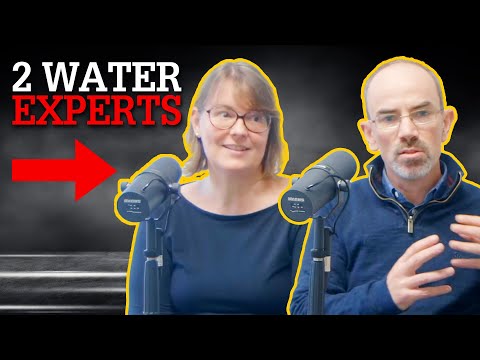
Sean Furey came on (don't) Waste Water once, alongside Kerstin Danert, for a deep dive into what actually works (and what does not) in rural water supply:
The company
Frequently asked
- Who is Sean Furey?
- Sean Furey is the director of the Rural Water Supply Network (RWSN), the global professional network for rural water, which he runs from Switzerland's Skat Foundation. A British and Swiss environmental scientist and water engineer, he has led the RWSN secretariat since 2017 and works to connect over 15,000 rural water professionals worldwide.
- What is the Rural Water Supply Network (RWSN)?
- The Rural Water Supply Network is the global practitioner network for rural water supply, hosted by Switzerland's Skat Foundation. Founded in 1992 as the Hand Pump Technology Network, it now links over 15,000 members, mostly in sub-Saharan Africa, through training, peer-reviewed publications and partnerships that bridge research, practice and policy.
- How did Sean Furey get into rural water?
- Sean Furey studied Environmental Science at the University of East Anglia and did his theses on fog-water harvesting, then took a master's in community water supply at Cranfield. He worked for the UK Environment Agency on water resources regulation before joining the Skat Foundation in 2011 and rising to direct RWSN.
- Is Sean Furey the same as RWSN or Skat Foundation?
- Sean Furey is the person who directs RWSN; RWSN is the network, and the Skat Foundation is the Swiss NGO that hosts it. RWSN is not a company or legal entity but a partnership of development banks, UN agencies, NGOs and researchers, with Furey running its small secretariat as, in his words, the circus master.
- What does Sean Furey say is the real problem in rural water?
- Sean Furey argues the binding constraint is rarely money and almost always capacity. Development banks can mobilise hundreds of millions, but institutions often cannot absorb it. He reframes success away from counting broken handpumps toward whether people get a lasting service, which pushes him toward locally run, paid-for water enterprises.
- Where can I listen to Sean Furey on (don't) Waste Water?
- Sean Furey appeared on (don't) Waste Water in February 2024, alongside Kerstin Danert, in an episode on the do's and don'ts of rural water supply recorded 100 days after MrBeast's water campaign. You can read the article, listen on the podcast, or watch the full conversation on YouTube, all linked above.