Paul Martin
Founder & Process Development Consultant at Spitfire Research
Chemical process engineer, founder of Spitfire Research and co-founder of the Hydrogen Science Coalition, and one of the most-quoted skeptics of hydrogen hype, the self-described antidote to marketing #hopium.
Compiled by Antoine Walter - from insight gathered on and off his (don’t) Waste Water microphone!
Paul Martin is a chemical process engineer, founder of the Toronto consultancy Spitfire Research and a co-founder of the Hydrogen Science Coalition. After 25 years building first-of-their-kind pilot plants, he became one of energy's most-quoted hydrogen skeptics, arguing that most hydrogen sold today is fossil-derived and that the water it uses is a red herring. As of 2026.
Paul Martin did not become the internet's favorite hydrogen skeptic by accident, and to understand how he got there you have to start with the pilot plants. Martin trained as a chemical engineer at the University of Waterloo, did his first real work on advanced-oxidation water treatment and the cleanup of contaminated groundwater, and then in 1996 joined Zeton, a Burlington firm that he describes, with no false modesty, as "the world's largest designer and builder of pilot plants." He spent 25 years there, partly owns it, and is still loosely involved, and in that time, as he puts it, he saw "every kind of new chemical process technology you can imagine, from the sublime to the ridiculous." That is the seat he is talking from: the place where a clever energy idea meets a furnace, a pump and a budget, and either survives or does not.
Paul Martin's most useful contribution to the water world is to take a worry off the table. People keep telling him, he says about five times a day on LinkedIn, that making hydrogen from water by electrolysis (splitting water with electricity) will gulp down impossible amounts of water. So he does the arithmetic with them, out loud: to make one kilogram of hydrogen you need about nine kilograms of pure water, call it ten with losses, and desalinating that much seawater costs on the order of a few hundredths of a kilowatt-hour. Set against the millions of cubic meters we move for farms and cities, the water that hydrogen would use is, in his words, "trivial, it's neither here nor there." The real constraint, the one he keeps dragging the conversation back to, is energy, because the thing that separates clean water from dirty water is energy, and the same is true of splitting water into hydrogen.
Paul Martin is blunt about where today's hydrogen actually comes from, and this is the line that gets him quoted. By his accounting, about 98.7 percent of the hydrogen you can buy is made from fossil fuels with no carbon capture, and the rest is mostly an unwanted byproduct of other chemistry, so in practice "there's really only black hydrogen in the world right now." He is just as hard on the fashionable alternative, the "blue" hydrogen made from natural gas with the carbon dioxide buried, because the process leaks methane, and methane traps about 86 times more heat than carbon dioxide over 20 years. His verdict, delivered deadpan, is that "blue hydrogen is really quite black." It is the kind of sentence that travels, and it is why a process engineer from Ontario has become a fixture in the global argument about the energy transition.
Paul Martin is not actually against hydrogen, which surprises people who only know him from the one-liners. He thinks it has a real and large role in the places that can make it cheaply, the sun-soaked, wind-rich spots near the sea where you can desalinate, run electrolyzers at high capacity, and ship the output out as ammonia or steel rather than as hydrogen itself, which is miserable to move. What he objects to is selling a fuel to the public on faith. And the tell of how Paul Martin operates is what he asks you to do at the end of an argument: rather than take his word for it, he points you to his LinkedIn or to spitfireresearch.com, where he publishes the references and the calculations, debates "very smart people who have forgotten more about certain topics than I'll ever know," and, by his own description, revises his opinion to match the data when the data changes. For an industry that runs on hopium, that is a rare and useful habit.
“Blue hydrogen is really quite black.”
Paul Martin is, in the end, the rarest kind of expert in a hyped field: a builder who has watched enough clever ideas die on contact with a real budget that he can tell you, with the receipts, which ones are worth the electricity. You can hear the full argument on his (don’t) Waste Water interview.
On (don’t) Waste Water
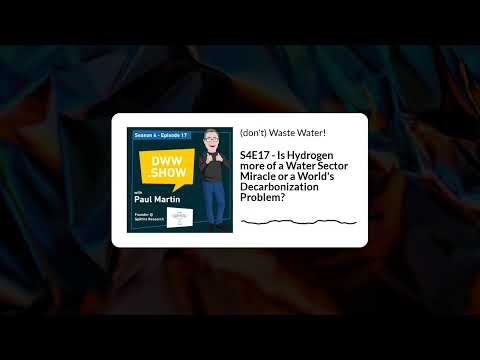
The time Paul Martin was a guest on the show (the 2022 interview, re-aired as a 2023 replay):
The company
Frequently asked
- Who is Paul Martin?
- Paul Martin is a Canadian chemical process engineer, the founder of the Toronto consultancy Spitfire Research, and a co-founder of the Hydrogen Science Coalition. After 25 years designing pilot plants at Zeton, he became one of the most-quoted hydrogen skeptics in energy, the self-described antidote to marketing "hopium."
- What is the Hydrogen Science Coalition?
- The Hydrogen Science Coalition is a group of academics and engineers, co-founded by Paul Martin in 2021, that offers evidence-based advice on hydrogen's role in decarbonization "without financial interest either in hydrogen or its alternatives." Paul Martin is one of its founders, not the coalition itself.
- Does making hydrogen from water use too much water?
- Paul Martin argues the water worry is a red herring. Making one kilogram of hydrogen needs about nine to ten kilograms of pure water, and desalinating that costs a fraction of a kilowatt-hour. Against the millions of cubic meters we already move, that volume is, in his words, "trivial." The real constraint is energy.
- What is blue hydrogen, and is it clean?
- Blue hydrogen is hydrogen made from natural gas with the carbon dioxide captured and buried. Paul Martin is skeptical: the process still leaks methane, which traps roughly 86 times more heat than carbon dioxide over 20 years, so by his accounting "blue hydrogen is really quite black."
- Where can I listen to Paul Martin on (don’t) Waste Water?
- Paul Martin was a guest on (don’t) Waste Water for the interview "Is Hydrogen More of a Water Sector Miracle or a World's Decarbonization Problem?", first aired in 2022 and replayed in 2023. The episode is linked above to read, listen, or watch.