Jon Freedman
President, International Desalination and Reuse Association at IDRA
Water-policy advocate who spent a career at GE, SUEZ and Veolia making the case that the technology to reuse water already works, and policy and pricing are the real bottleneck. Now President of the International Desalination and Reuse Association.
Compiled by Antoine Walter - from insight gathered on and off his (don't) Waste Water microphone!
Jon Freedman is a water-policy advocate who, across a career at GE, SUEZ and Veolia, made the case that the technology to reuse wastewater already works and the real bottleneck is policy and pricing. He wrote a menu of about 100 reuse policies from 30 countries that governments copy from, and is now President of the International Desalination and Reuse Association, as of 2026.
Jon Freedman did not start out as a water person, he started out as a lawyer. He took a history degree at the University of Virginia, a law degree from William and Mary, and an MBA from the Wharton School, and his early jobs were corporate ones, general counsel and business development inside SUEZ in the 1990s, then more than a decade at GE, where he helped build GE's global water business by leading acquisitions and co-created the company's big environmental initiative, Ecomagination. When GE's water arm became SUEZ Water Technologies and Solutions in 2017, Jon Freedman was the person carrying its message to governments, and that is the role he held when he came on the show in 2022.
Jon Freedman's job title was Global Government Affairs Leader, which sounds abstract until he explains it, so here is how he put it on the podcast: he does two things, he engages with governments around the world to advocate for sustainable water policies, and he tries to position his company as the place a government calls when it is about to write a new water rule. The company behind him was not small, 50,000 customers in more than 100 countries, with an installed base of over a thousand membrane bioreactors (the biological-plus-membrane treatment trains that are the workhorse of water reuse, one of the water technologies I track) treating more than a billion gallons of wastewater a day. So when Jon Freedman argues that the technology to reuse water is already proven, he is speaking from a fleet that does it daily.
Jon Freedman's most distinctive contribution is a very simple idea executed well. Governments that want to encourage water reuse rarely know where to start, and the good policies are scattered across the world, so Jon Freedman wrote a white paper that pulled about 100 reuse policies from roughly 30 countries into one place and organised them as a menu officials could choose from. The proof that it landed is a story he tells with obvious delight, the head of the EU's environment directorate called his company and asked to be put in touch with the Jon Freedman whose report was sitting on the desk. He did the same thing for India, flying to Delhi just before COVID to present a country-specific version to four government ministers.
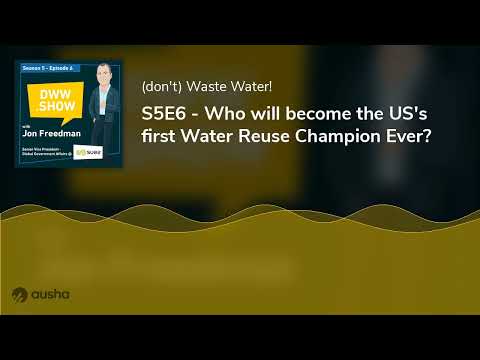
Jon Freedman came on (don't) Waste Water in 2022 to talk about an award. When the US federal government published its first National Water Reuse Action Plan in 2021, Jon Freedman took ownership of one of its action items, creating a national Water Reuse Champion award to get corporations to compete on recycling water, built with the US Chamber of Commerce, the University of Pennsylvania and the WateReuse Association. The logic behind it is the thread that runs through everything he argues, the technology is not the problem, the economics are. In the US an average water tariff works out to roughly a penny a gallon, so when water is almost free, almost nobody invests in reusing it, and his answer is policy, incentives, the removal of economic barriers, and recognition for the companies that move first.
Jon Freedman's sharpest opinion is one he is careful to flag as his own and not his employer's, that the water world is too fragmented, with the World Bank, the philanthropies and the governments all working hard but rarely in concert, and that getting them to pull together is, in his words, the key to the kingdom. What I like about Jon Freedman is that he holds that conviction lightly, he told me that every time he is sure he is right, he ends up learning he was wrong, and he gave a real example against his own enthusiasm, the pushback he got from big centralised-reuse players when he championed a decentralised model. He has kept widening the same argument since the episode, teaching it at Wharton and the University of Pennsylvania and now carrying it globally as President of the International Desalination and Reuse Association for the 2024 to 2026 term.
“My personal observation is that the world is taking too fragmented an approach to water challenges. You have great organizations like the World Bank, tremendous philanthropies, but they're not working in concert with one another. I think we need to find a way to get governments, NGOs and philanthropies working in concert so we can achieve scale and greater impact. I really think that's the key to the kingdom.”
Jon Freedman is, in the end, a translator: someone fluent in both the engineering and the statute book, who has spent thirty years telling governments that the hard part of the water crisis was never the science.
On (don’t) Waste Water
Jon Freedman sat down for one full interview on (don't) Waste Water:
The company
Frequently asked
- Who is Jon Freedman?
- Jon Freedman is a water-policy advocate who spent his career in government affairs at GE, SUEZ and Veolia, arguing that the technology to reuse water already works and policy is the bottleneck. He now serves as President of the International Desalination and Reuse Association for the 2024 to 2026 term.
- What does Jon Freedman do in water policy?
- Jon Freedman advises governments on water reuse policy. He authored a widely cited menu of about 100 reuse policies from 30 countries that officials adapt, owns a US national Water Reuse Champion award initiative, and chairs the WateReuse Association's policy committee, translating water technology into rules governments can actually pass.
- Where did Jon Freedman work, and where is he now?
- Jon Freedman led global government affairs at SUEZ Water Technologies and Solutions from 2017, continuing through its merger into Veolia, then moved to Veralto's water-quality business in 2024. As of 2026 his most prominent active role is President of the International Desalination and Reuse Association.
- What is Jon Freedman's main argument about water reuse?
- Jon Freedman argues the technology to reuse wastewater is already proven, but economics block it: in the US, water costs roughly a penny a gallon, so nobody invests in recycling it. Globally only about 2% of collected, treated wastewater is reused, an untapped reservoir he says policy must unlock.
- Is Jon Freedman the same as SUEZ or Veolia?
- No. Jon Freedman is the person, not the company. He was the Senior Vice President for global government affairs at SUEZ Water Technologies and Solutions (now part of Veolia) from 2017 to 2024, but he speaks and advocates as an individual water-policy expert, not as the firm itself.