Geoff Ward
Clean-energy executive, former CEO at Hazer Group
Clean-energy executive who, as CEO of Australia's Hazer Group, built the world-first demonstration of "turquoise hydrogen" - making a wastewater plant carbon-negative by turning its biogas into hydrogen and solid graphite.
Compiled by Antoine Walter - from insight gathered on and off his (don’t) Waste Water microphone! As of June 2026.
Geoff Ward is an Australian clean-energy executive who, as CEO of the ASX-listed Hazer Group from 2018 to 2022, built the world-first demonstration of turquoise hydrogen: splitting biogas so the carbon falls out as solid graphite instead of CO2, which makes a wastewater treatment plant carbon-negative. He explained the whole idea on the show in 2022.
Geoff Ward is a chemical engineer who spent twenty-five years in energy and resources before becoming one of the more interesting CEOs in clean hydrogen. He trained at the University of Melbourne, took an MBA at the University of Western Australia, and worked his way through Woodside Energy, the advisory firm Azure Capital, and a five-year run as CEO of the geothermal company Geodynamics. From 2018 to 2022 he ran Hazer Group, the Perth-born technology company at the centre of his episode. He has since moved on, and today, based in Brisbane, he sits on the board of a solar technology company and chairs another business. The thing he is known for in water is what he built at Hazer.
Geoff Ward came on the show to explain an idea that sounds almost too neat to be real: making a wastewater treatment plant carbon-negative. The trick is a process called methane pyrolysis, which is a fancy way of saying you split methane gas without burning it. The usual way to make hydrogen, called steam methane reforming, takes methane and produces roughly 8 kilograms of CO2 for every kilogram of hydrogen, because all the carbon in the gas ends up bonded to oxygen and floats off as CO2. Hazer's process splits the same gas but lets the carbon turn straight from gas to a solid, so you walk away with hydrogen and a dry black graphite powder you can bag, truck, and sell.
Geoff Ward's clever move was where he chose to prove it. A wastewater treatment plant already makes methane, because the bugs that digest sewage sludge give off biogas, and most plants simply burn or flare it. Feed that biogas into the Hazer process instead, and the carbon you pull out was recently in the atmosphere anyway, so capturing it as solid graphite makes the whole chain carbon-negative rather than just clean. Hazer built its demonstration plant on the Woodman Point Water Recovery Facility in Perth, on land the local water utility lent them, running on gas that was otherwise being flared. It is the kind of overlooked, capital-starved corner of the water world I spend my days mapping in my Leviathan database, and Geoff turned it into a hydrogen plant with a million-dollar view.
Geoff Ward is refreshingly unsentimental about how hard this is. His hardest-won lesson, he said on the show, is that developing a new technology in an emerging market is incredibly hard, so convincing anyone to be the first to try something is the real battle. He is just as blunt about the cost of everyone waiting for someone else to move, which, he warned, gets you a lot of intent but very little action on hard-to-abate sectors. He is also careful not to oversell hydrogen against batteries: in his framing you are not competing against electric vehicles at all, you are competing alongside them to replace diesel.
Geoff Ward left Hazer in late 2022, before the plant he set up reached its goal, but the goal was reached. In early 2024 the Woodman Point demonstration produced its first hydrogen and graphite, designed for about 100 tonnes of hydrogen and 380 tonnes of graphite a year, which makes it one of the first working proofs that a sewage works can double as a hydrogen plant. His episode was the third and last part of a Hydrogen Economy trilogy, and you can hear Geoff lay out the whole idea, gently correcting my muggle questions about chemistry along the way, in the episode below.
“Rather than the carbon having the ability to bond with oxygen and come out as CO2, the carbon sublimates. It goes directly from a gas to a solid state, and we produce a dry black graphitic carbon powder.”
On (don’t) Waste Water
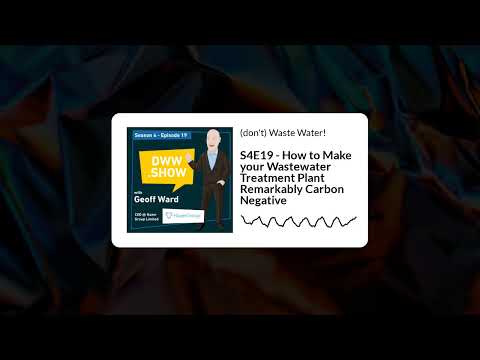
The one time Geoff Ward was a guest on the show, the closing chapter of a three-part hydrogen series:
The company
Frequently asked
- Who is Geoff Ward?
- Geoff Ward is an Australian clean-energy executive and chemical engineer who was CEO of Hazer Group, an ASX-listed hydrogen and graphite technology company, from 2018 to 2022. He came on (don’t) Waste Water in 2022 to explain how Hazer's process can make a wastewater treatment plant carbon-negative.
- What is turquoise hydrogen, and how is it different?
- Turquoise hydrogen is hydrogen made by methane pyrolysis, which splits methane into hydrogen and a solid carbon by-product instead of CO2. Geoff Ward explained that conventional steam methane reforming emits roughly 8 kilograms of CO2 per kilogram of hydrogen, while pyrolysis traps that carbon as solid graphite you can sell.
- What is the Hazer process, and what does Hazer Group do?
- Hazer Group is an ASX-listed Australian clean-technology company, founded in 2010 as a University of Western Australia spin-out. The Hazer process uses methane pyrolysis to make low-emission "turquoise" hydrogen plus a graphitic-carbon by-product. Under Geoff Ward, Hazer built its first commercial demonstration plant on a Perth wastewater treatment plant.
- How can a wastewater treatment plant be carbon-negative?
- A wastewater treatment plant already produces biogas when bacteria digest sewage sludge, and most plants just flare it. Geoff Ward's idea was to feed that biogas through the Hazer process, capturing its carbon as solid graphite. Because the carbon was recently atmospheric, the whole chain becomes carbon-negative, not merely clean.
- Is Geoff Ward still the CEO of Hazer Group?
- Geoff Ward is no longer CEO of Hazer Group; he led the company from 2018 until late 2022 and has since moved on, today based in Brisbane with board and advisory roles in solar technology and other businesses. The demonstration plant he set up produced its first hydrogen and graphite in 2024.