Emily Hicks
Co-Founder & COO at FREDsense Technologies
Co-founder and COO of FREDsense Technologies, the Calgary company whose field kit tests for PFAS in days, on site, instead of the weeks a lab takes.
Compiled by Antoine Walter - from insight gathered on and off his (don’t) Waste Water microphone!
Emily Hicks is the co-founder and COO of FREDsense Technologies, a Calgary water-tech company whose field kit is built to test for PFAS, the "forever chemicals," in about five days on site instead of the weeks an accredited lab takes. FREDsense grew out of a student synthetic-biology project, was founded in 2014, and has raised $10.5 million as of 2026.
Emily Hicks did not set out to start a water company. She studied biomedical sciences at the University of Calgary, and the thing that turned into FREDsense started as a student team in the iGEM competition, which is the International Genetically Engineered Machines contest where university students build something useful out of synthetic biology. Emily led the Calgary team for four summers running, and the idea they kept circling was simple and a little audacious: engineer bacteria to act as living sensors, so that when they meet a specific contaminant in water they spit out an electrical signal you can actually measure. That became the company's name, FRED, short for Field Ready Electrochemical Detector, and the company was founded in 2014 with Emily as co-founder alongside CEO David Lloyd.
Emily Hicks spent the first decade doing the unglamorous work of finding out what the market actually wanted, which mostly meant being wrong in public and pivoting. FREDsense's very first sensor was built for oil-and-gas contaminants called naphthenic acids, then the company moved to arsenic, where Emily found a real and stubborn problem: even fairly large utilities still ship their samples to third-party labs and wait a month for the result, which is not much use if you are trying to run a treatment system in real time. But arsenic was always a small market, so they sat down, did a big market analysis (some of it with this very podcast, as it happens), and the answer that came back was PFAS. By far, PFAS was the biggest opportunity, and the field kit they built around it is what put FREDsense on the map.
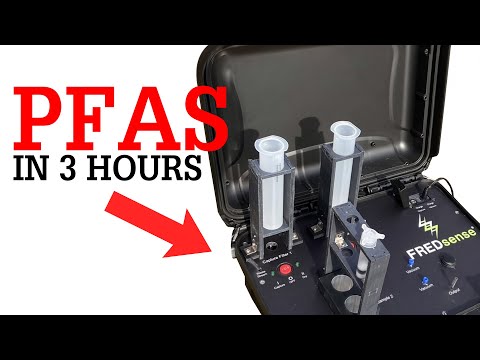
Emily Hicks is careful about the science, and the PFAS kit is a good example of why that matters. PFAS, the per- and polyfluoroalkyl substances behind non-stick coatings and firefighting foam, are notoriously hard to even detect at the levels regulators care about, and most testing today happens in an accredited lab over a matter of weeks. FREDsense's kit uses a bio-inspired polymer, built from a plant material they have customised, that selectively grabs PFAS and displaces a fluorescent dye, so the drop in that fluorescent signal is the reading. The company runs only PFAS, nothing else, which keeps it streamlined, and the result an industrial customer or a remediation crew gets is the one number they came for, in roughly five days on site rather than the weeks a lab takes. The FRED-PFAS field kit launched in January 2025, and Emily says they are already seeing more demand than they can fill.
Emily Hicks is also refreshingly honest about the parts that are still hard, which is rare in a founder. She has said FREDsense ticked all the wrong boxes for an investor: young founders, first-timers, working in the slow-moving water sector, and deep tech with a hardware component on top. The company answered that the scrappy way, building its first lab out of Amazon, eBay and government-surplus equipment, and the odd piece a friend-of-a-friend rescued from a university lab on a Friday afternoon. She is just as straight about the technical ceiling: the kit cannot yet detect down to four parts per trillion, the US federal drinking-water limit, so there are compliance jobs it cannot do today, and getting there is the goal rather than a done deal. That candour is the point, because it is what makes the audited version of her story land harder than a hyped one.
Emily Hicks has the receipts the market eventually rewarded. FREDsense has raised $10.5 million to date, a $2 million seed in 2021 led by BDC Capital, a $1.5 million round in 2024, and a $7 million Series A in September 2025 led by HG Ventures with Emerald Technology Ventures, money pointed squarely at scaling the PFAS field kit. Along the way the company was one of the first seven into Singularity University's accelerator, and Emily picked up a stack of recognition, including a National Nicol entrepreneurial award and two separate Top 30 under 30 nods. After eleven years as FREDsense's president she handed that role to a water-industry operator in 2025 and moved into the COO seat, which is roughly the founder's version of hiring the person who runs the trains so you can keep building them.
“We did a big market analysis. We did some work with Don't Waste Water to kind of look out at the market. And really the big thing that came back was PFAS. By far, PFAS was the biggest opportunity.”
Emily Hicks is, in the end, a scientist who learned to listen to a market: someone who will pivot the chemistry twice and admit what the kit still can't do, which is exactly why FREDsense's PFAS bet reads as earned rather than fashionable.
On (don’t) Waste Water
Emily Hicks came on (don’t) Waste Water to explain how FREDsense tests PFAS in days instead of weeks:
The company
Frequently asked
- Who is Emily Hicks?
- Emily Hicks is the co-founder and COO of FREDsense Technologies, a Calgary water-tech company she helped spin out of a University of Calgary synthetic-biology project in 2014. She led the company as president for over a decade, building its rapid, field-based water testing technology, before moving into the COO role in 2025.
- What does FREDsense do?
- FREDsense Technologies makes rapid, field-deployable water testing. Its FRED platform (Field Ready Electrochemical Detector) uses engineered bacteria as biosensors to measure contaminants like arsenic on site, and its FRED-PFAS field kit detects PFAS "forever chemicals" in roughly five days in the field, instead of the weeks an accredited lab takes.
- How did Emily Hicks start FREDsense?
- Emily Hicks led the University of Calgary team in the iGEM synthetic-biology competition for four summers, and that work became FREDsense in 2014. The company first built sensors for oil-and-gas contaminants, then arsenic, then pivoted to PFAS after a market analysis showed PFAS was, in her words, by far the biggest opportunity.
- How much funding has FREDsense raised?
- FREDsense has raised $10.5 million as of 2026: a $2 million seed in 2021 led by BDC Capital, a $1.5 million round in 2024, and a $7 million Series A in September 2025 led by HG Ventures with Emerald Technology Ventures. The funding backs the rollout of its PFAS field kit.
- Where is Emily Hicks based?
- Emily Hicks is based in Calgary, Alberta, Canada, where FREDsense Technologies is headquartered. She studied biomedical sciences at the University of Calgary, and the company grew directly out of the iGEM competition team she led there.
- Is Emily Hicks the CEO of FREDsense?
- Emily Hicks is the co-founder and COO of FREDsense, not the CEO. FREDsense's co-founder and CEO is David Lloyd. Emily served as the company's president from 2014 until 2025, when a new president was appointed and she moved into the chief operating officer role.