Ali Ling
Assistant Professor of Civil Engineering at University of St. Thomas
Civil engineer whose estimates show PFAS cleanup at today’s emissions would likely cost more than world GDP, and industrial source control 1,000 times less.
Compiled by Antoine Walter - from insight gathered on and off his (don’t) Waste Water microphone! Updated November 2026.
Ali Ling is an assistant professor of civil engineering at Minnesota’s University of St. Thomas. Her 2024 paper found removing perfluoroalkyl acids, one branch of PFAS, from the environment at current emission rates would cost US$20 to 7,000 trillion a year, up to 66 times world GDP. As of 2026, she argues industrial source control is about 1,000 times cheaper.
Ali Ling’s road to PFAS started with sewer corrosion. Her PhD at the University of Colorado Boulder, finished in 2013, studied the microbes that live on the walls of concrete sewers, eat hydrogen sulfide gas and turn it into sulfuric acid, which then eats the concrete, and it ended in a patent with her advisor Mark Hernandez on a way to stop them. Before that she had worked on microbial fuel cells at Tsinghua University in Beijing in 2008, which is the paper I dug out of the archives before our conversation, and she describes the path since then as “a very convoluted road”. The University of Minnesota, where she earned her civil engineering degree in 2008, describes her as a self-professed “microbe nerd”, and engineering runs in the family: her grandparents, Joseph and Rose Ling, immigrated to the United States from China, and Joseph earned his doctorate in sanitary engineering at Minnesota in 1952.
Ali Ling then spent nine years at Barr Engineering in Minneapolis, from 2014 to 2023, solving the same puzzle for mining, agriculture, manufacturing, power and municipal clients: water arrives at point A carrying arsenic or some obscure organic compound, it has to leave at discharge quality, and you design the treatment train in between. Towards the end of that run she was one of the technical leads on a study for the Minnesota Pollution Control Agency that asked what it would cost to remove PFAS from wastewater effluent, landfill leachate, compost contact water and biosolids with technology already on the market. The answer, published in June 2023, was US$14 to 28 billion over 20 years for the state’s municipal wastewater, or US$2.7 to 18 million per pound of PFAS removed and destroyed, when the same pound costs US$50 to 1,000 to buy. She was not the PFAS expert of her group, she told me, but zooming out and bridging topics is what she is good at.
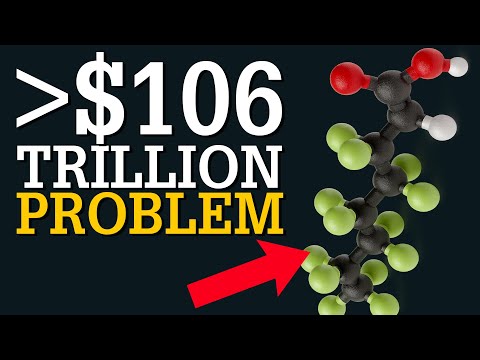
Ali Ling joined the University of St. Thomas in 2023, and in 2024 she published the paper that was the first thing I ever read from her, in Science of the Total Environment: removing perfluoroalkyl acids, the PFAS branch that includes PFOA and PFOS, from the environment at current emission rates would cost US$20 to 7,000 trillion a year. That sounds too big to picture, so here is the yardstick: the whole world economy produces about US$106 trillion a year, which means even the low end is a fifth of everything humanity earns, and the high end is 7,000 divided by 106, so about 66 world economies, every single year. Le Monde’s Forever Lobbying Project then brought her in to build the cost method for Europe with the environmental chemist Hans Peter Arp, and in January 2025 the estimate ran from €4.8 billion a year under optimistic assumptions to about €100 billion a year once the short-chain PFAS are counted, work the team turned into a peer-reviewed paper in 2026.
Ali Ling insists the trillion-dollar figure was written as a prioritisation tool, because people see it and feel there is no hope, when the message is that the bill shrinks the further upstream you go. Her back-of-envelope math says a kilogram of PFAS costs millions of dollars to pull out of the environment, hundreds to thousands to catch at an industrial discharge, and probably less again to stop using them where alternatives exist, so the first step upstream alone is roughly a thousandfold saving. That is why she thinks treating municipal wastewater effluent “doesn’t really make sense” while industrial pretreatment does. She also points to a quiet success story: over the past 20 years, as PFOA and PFOS were largely phased out, PFOS in human blood fell by roughly a factor of ten. The next worry, in her view, is TFA, the smallest PFAS, whose concentration in river water has risen about 100-fold over the last couple of decades. (I unpacked the whole argument, including who pays, in PFAS cleanup cost: why the first dollar belongs upstream.)
Ali Ling’s main job today is teaching Water Resources Engineering, Environmental Engineering, Water Treatment and Intro to Engineering Design, and she uses PFAS as a case study rather than as the most important topic in the field, because what she wants her students to learn is systems thinking. Her research runs on a slice of her time and some State of Minnesota money for regional PFAS management options. She has also worked with the Minnesota Pollution Control Agency on what an alternative to spreading biosolids on fields would cost, and her 2025 paper maps what to do with the spent treatment media (the used activated carbon and resins) that PFAS treatment leaves behind. She sits on BlueTech’s technical advisory group, was named to the American Academy of Environmental Engineers and Scientists’ 40 Under 40 list for 2025, and posts plain-spoken PFAS explainers on LinkedIn. And the unsung tool she could not live without is Microsoft Paint, next to Excel and Word, for rearranging screenshots in her lectures (a first in my rapid-fire history: I had Excel once, never Paint).
“As a consultant, I got a lot of calls from random startups that said, hey, we've got this great thing. And I would say, show me your data.”
Ali Ling’s advice to the founders of the roughly 1,000 early-stage water start-ups follows from that: decide how much data you are willing to share, because consultants, and the clients behind them, trust what they understand. Hear the whole hour below, then read the article, and if you want the companies selling PFAS destruction, they are in the PFAS, Oxidation & Contaminant Destruction section of the Water-Tech pillar.
On (don’t) Waste Water
The one time Ali was a guest on the show, in Season 13:
The company
Frequently asked
- Who is Ali Ling?
- Ali Ling is an assistant professor of civil engineering at Minnesota’s University of St. Thomas and a registered professional engineer. After a PhD at the University of Colorado Boulder and nine years at Barr Engineering, she researches the costs and impacts of PFAS treatment, and made the AAEES 40 Under 40 list for 2025.
- How much would it cost to remove PFAS from the environment?
- Ali Ling’s 2024 paper in Science of the Total Environment estimates that removing perfluoroalkyl acids, one branch of the PFAS family, from the environment at current emission rates would cost US$20 to 7,000 trillion a year, against world GDP of about US$106 trillion. Counting all PFAS could multiply that by 10 to 10,000.
- Is Ali Ling the same person as Alison Ling?
- Ali Ling and Alison L. Ling are the same person: she publishes under her full name, the one on her Google Scholar profile and on papers such as the 2024 PFAS cost estimate. Both names refer to the University of St. Thomas civil engineering professor, who goes by Ali on podcasts and in the press.
- Why does Ali Ling say PFAS source reduction beats cleanup?
- Ali Ling’s back-of-envelope math puts the cost of removing PFAS already in the environment at millions of dollars per kilogram, against hundreds to thousands at an industrial discharge. That roughly 1,000-fold gap is why she argues for industrial pretreatment, use restrictions and phase-outs before treating municipal wastewater effluent.
- What did Ali Ling do for Le Monde’s Forever Lobbying Project?
- Ali Ling built the cost methodology for the 2025 Forever Lobbying Project with Hans Peter Arp of the Norwegian University of Science and Technology, applying US cost models to Europe’s wastewater and drinking water plants. The estimate ran from €4.8 billion a year on optimistic assumptions to about €100 billion with short-chain PFAS counted.