💧 The European Water Tech Accelerator aims to boost European water start-ups to drive sustainable growth in the global water sector.


This episode is part of my series on (successful) Water Entrepreneurship – check it out! 😀
What we covered:
🍏 How Environment, Economy, and Society shall work together to achieve a triple win, usually known as Sustainable Development
🍏 How Finance and Venture Capital shall be much more involved if we aim at a successful outcome
🍏 The strengths European start-ups usually draw on, but also the common weaknesses they share
🍏 How Market Positioning, Business Model, Go-To-Market Strategy, and Mindset often are the Water Industry Four Horsemen of the Apocalypse.
🍏 Which type of company is the rarest whilst presenting the most potential
🍏 The ecosystem differences between North-America, Europe, and Asia
🍏 How radical differentiation and transposition innovation might be applied to the Water Sector
🍏 Hypergrowth as a strategy in the Water Industry
🍏 New ways to tackle the innovation value chain
🔥 … and of course, we concluded with the 𝙧𝙖𝙥𝙞𝙙 𝙛𝙞𝙧𝙚 𝙦𝙪𝙚𝙨𝙩𝙞𝙤𝙣𝙨 🔥
Teaser:
Resources:
➡️ Send your warm regards to Gaetane on LinkedIn
➡️ Check the European Water Tech Accelerator’s Page
is on Linkedin ➡️
Infographic: Entrepreneurship in the Water Industry
Table of contents
Full Transcript:
These are computer generated, so expect some typos 🙂
Antoine Walter:
Hi Gaetane, Welcome to the show.
Gaetane Suzenet:
Thank you, Antoine. Thank you very much. That’s very nice of you to have me on your program. Well, first of all, you know, on this very special day, I would like to wish everyone, you know, a happy world water day. I know probably it’s not going to be broadcasted on that day, but,
Antoine Walter:
But it’s important to mention that yeah, we are recording actually on the world water day. So let’s make something which is at the level of that event. Because you know, it’s one day in the year, hopefully they are more than one day in the year where people put water in the spot. But if there’s one it’s today,
Gaetane Suzenet:
It’s today indeed. Yes. So hopefully, you know, it, it should be everyday, as you say, but let’s say break, you know, at least one day today.
Antoine Walter:
Absolutely. It’s good to have you on the show because you have a profile, which is rare, at least from my end of the water sector, because many previous guests of that podcast have mentioned regulations, finance to be very important drivers to this industry. But you’re the very first guest I have, which is directly touching these topics. Does that mean that because you know the regulation because you’re shaping the regulation that, you know, the future of this industry?
Gaetane Suzenet:
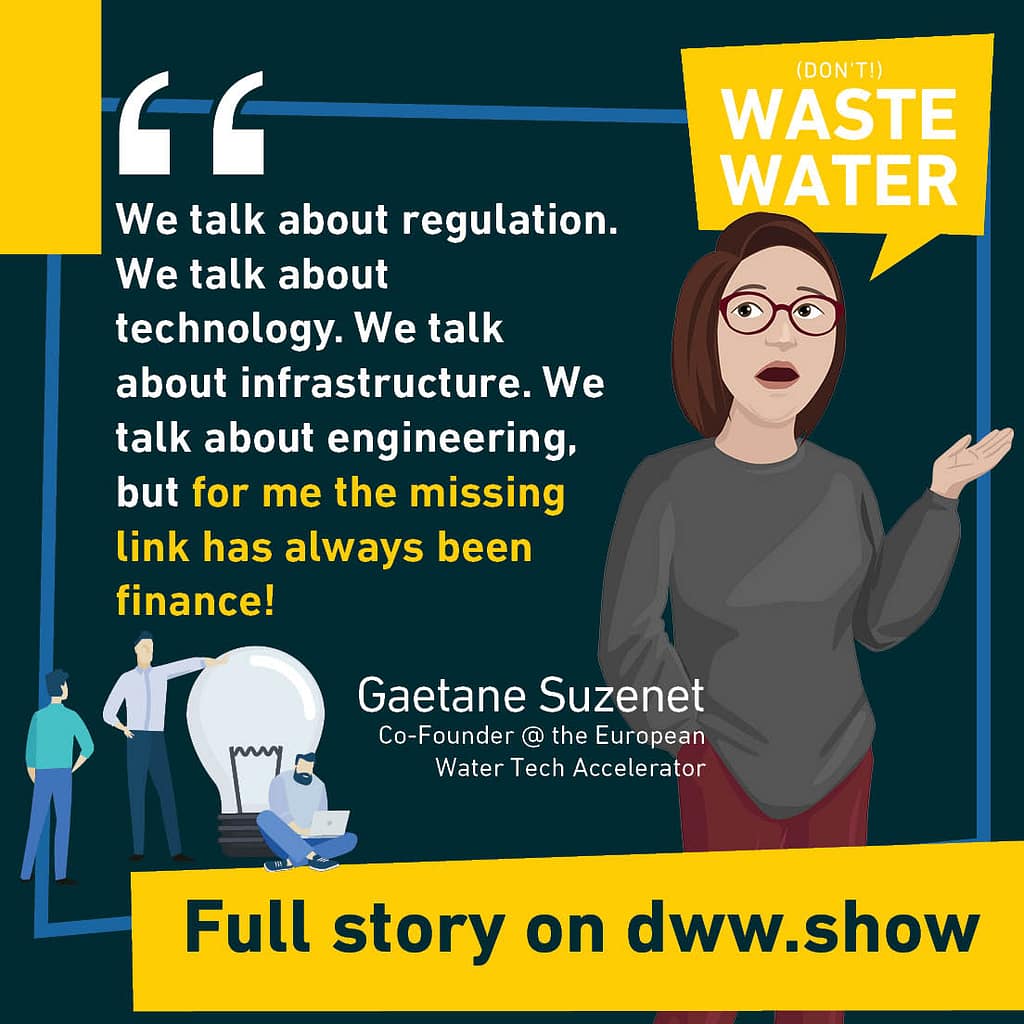
Well, thank you Antoine. I wish, you know, I would, but at least, you know, what I’m doing or trying to do is to shape the future, you know, for the best for the water industry. So it doesn’t mean that I know it, I wish, you know, I would, but what I’ve been trying to do over the last 25 years, it’s very much, you know, shaping the future and thinking forward and not backward, you know, bringing the water sector into the future. Very modestly. We have very good people in the water industry of course. But yeah, my objective has always been to make sure that we have, you know, the tools and instruments for the future. And since you mentioned finance, finance was actually the area, which I think was really missing in our discussion. We talk about regulation. We talk about technology. We talk about infrastructure. We talk about engineering, but for me, the missing link has been finance. And that’s why I have decided to raise this agenda for the water industry.
Antoine Walter:
How did you actually do that? You mentioned that 25 years, which I wouldn’t have spontaneously because you know, I have sometimes to be a gentleman, but now, that’s, you’ve raised it. Can you just swiftly guide us through your steps as we understand these elements of the finance, which is going to be our deep dive, but also the regulation aspect shaping the industry. I love that. That way. Sorry. Now I shut up.
Gaetane Suzenet:
No, that’s absolutely fine. Don’t worry. I’ve never had actually an agenda. You know, when I got into the water sector and I’ve always been driven by the endgame, I wanted to make sure that I contributed to societal objectives, now it sounds, you know, a bit like, you know, very esoteric and, you know, like, and everybody could say that, but that’s true. In fact, and when I decided I would work in the water sector, I would always picked up opportunities in which I could be useful, shape the future and make sure that there is a win-win situation for everyone. So I’ve never got into, for instance, you know, the public private debate. I think that’s ridiculous because we all work for the same objective and I had the pleasure and opportunity to work for the UK water industry. So I always in the best position, because as you know, the UK water industry is public and private.
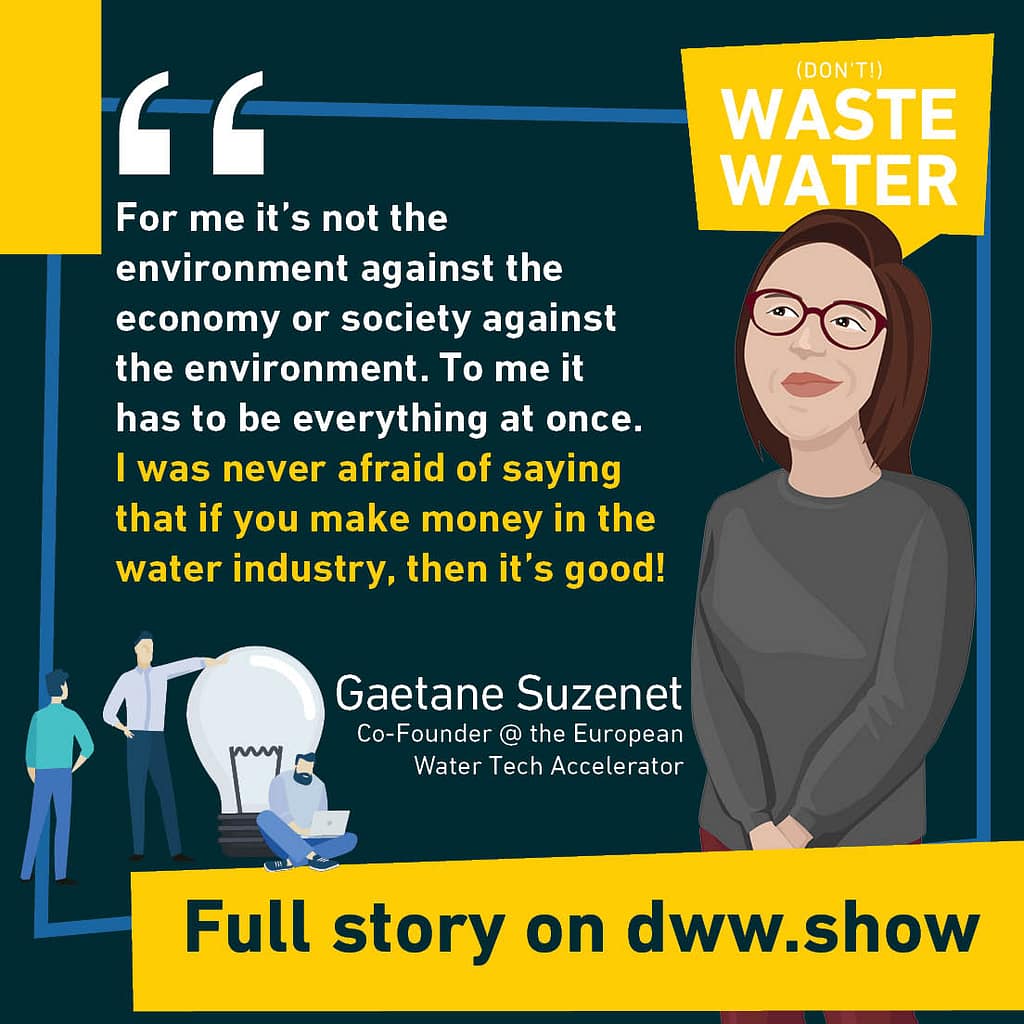
So really for me, the objectives were very much, you know, environmental, economic and societal. So the sustainability agenda for me was actually a very good framework to work within. And when I say economics, for me, it’s not, you know, the environment against the economy or society against the environment for me, it’s everything. So I was never afraid of saying that if you make money in the water industry, then it’s good. And I was never afraid that you can actually already consigned the fact that you can make money because this money can be injected into investment and you can make money while providing water, safe water to people. You can improve wellbeing, you can improve health. And at the same time you can also improve the environment. So there’s no contradiction between the phrase trans there’s no contradiction between public and private. For me, we all working towards the same objective and that’s, I know I’m not doing my CV here, which I think would be boring, but it’s just to say that alongside these 25 years, for me, it was very much what has driven the things that it was very meaningful to me.
And that’s, what’s driven my carrier up to now.
Antoine Walter:
Well, that gives us a smooth transition into our deep dive because actually one of the thrusts of sustainable development is this economical aspect. And in your latest venture. So the European water tech accelerator, you are aiming at bringing that element of finance and probably let’s use the big word venture capital inside the water industry. And I’d like to start, you know, for the muggles like me, which don’t know that magical word of finance. So let’s start by just defining what is the European water tech accelerator?
Gaetane Suzenet:
The European water tech accelerator was actually set up last year. And with my co-founder Jacob Tompkins, we decided to set it up because we could see a gap in Europe, despite the fact that you have very good organizations, excellent organizations wanting, you know, to move the water agenda forward. What we’ve seen as a gap is you have a lot of startups, but these startups can scale up. I mean, you haven’t seen yet, unless you are able to name one company, which has been able to scale up and get to the Google same arena. We don’t see any. So we’ve seen a gap in this, and that’s why we with Jacob, we have decided to set up the European Water Tech Accelerator for this particular reason. We want to accelerate just a few companies. So not 150 companies, rather, you know, 15 companies, which will become European Water Champions.
Antoine Walter:
So that’s the mission. And how do you intend to achieve that? That’s a good question. That’s a broad question.
Gaetane Suzenet:
Very broad question. I think, you know, one thing that we have noticed in the water sector is that we have very good engineers. We have very good tech. What we are missing is entrepreneurs, and I’m not going to be very popular when I say that. And the finance side of things. It’s starting, but it’s not there yet. And what we have noticed since you’re mentioning finance is that venture capitalists are still sort of reluctant to invest in the water sector. Funny enough, you know, I’m talking about this in today’s time, I’m doing a talk also to talk about, you know, investment in digital water. And I was looking at the portfolio of a very well-known investment fund in the water sector in Europe. There were set up in 2006 and they’ve done only seven investments in 14 years. 15 years. Yes. So that gives you the gap that we have two close between the startups and the venture capitalist, or I would say, you know, the financial world,
Antoine Walter:
I think there’s a lot to uncover in what you just said. First. I fully agree with you with that aspect of entrepreneurship. I think that’s the drawback of having an industry, which is full of engineers. We probably are very prone to the technical side, but if you have engineers everywhere in every role, they have to have their limits as well. And I guess there’s a broad limit on the entrepreneurship side. And of course the finance side of things. And what’s, you’re saying with the investment fund brings me back to a discussion I was having on that same microphone with Nicola Lei Ravello and he was mentioning the water sector is a very good investment for the sturdy long-term investments with low risk. And I guess that’s on the other end of that spectrum. If you’re into venture capital, that means that you are looking at something probably more risky, but also which can bring much more potential is that a reason why venture capital wasn’t that much involved in water, or do you see other barriers to their involvement?
Gaetane Suzenet:
This is certainly true that there’s this issue about the return on investment that venture capitalists are looking are usually looking for. So that has been a reason indeed, but there’s also, I think it’s not just a return on investment. There is also the issue of the market uptake, despite the fact that you’ve seen, you know, where every single line probably today we are going to see that being the world water today that water, you know, is a global issue. Water is life water is, you know, like the most important thing, you know, and the major risks, according to the world water forum, or, you know, where is the finance, where is the market,
Antoine Walter:
So, you’re saying that they’re not walking the talk?
Gaetane Suzenet:
No. And, and despite the fact that we keep saying that water and I’m sure you’ve been to all these conferences, you know, like where we could graduate ourselves by saying, you know, like that water will be the next thing I’ve said. Also that water would be the next investment, you know, area. I think, you know, there’s if, if the market is not ready yet for these innovations that are coming onto the market, then we have a problem. I think, you know, for successful innovation investment strategy, you need three things. You need entrepreneurs, you need scalability, which is market, and you need the tech. And for me, these are the three things which will make the water sector successful in the future, including not just, you know, like the big players, who are very successful. And in fact, if you look at I’m diverging a bit now, but if you look at the return rate for big water companies, they are pretty good. So now what we need to work on is how innovation is going to be attractive enough for this investment funds. Generally speaking, not just for VCs, but generally speaking. So they need to trust the fact that entrepreneurs will be able to sell their tech or their product to the market. And that the market is confident in the product as well.
Download my Latest Book - for Free!

Antoine Walter:
Is that where you step in as a startup accelerator? How,
Gaetane Suzenet:
Yeah, no, I think we need to work. I mean, obviously our core activity is to accelerate companies. So practically speaking, what we do is we are very selective. So having worked in an investment fund and working with investment funds, we are very selective. So that’s why we’re not going to accelerate many companies. And we do a due diligence and we have many conversations with the CEOs, with the team. We look at the tech and we look at the potential for scalability. Once we’ve done that, we work with the team on a program, which is tailor-made. So it’s not one size fits all. And we look at what areas we need to work on. So it can be finance, you know, how to prepare a pitch for investors. It can be how to pitch to the market. It can be the market positioning because sometimes many startups don’t know where they stand, you know, to this positioning against their competitors.
It can be looking at how to structure the team. It can be, you know, what kind of partnerships would be most useful to scale up quickly? Because the core of our activity is not just scaling up it’s to scale up quickly and back to your question about, you know, the Ray very long time, that’s precisely what we want to work on. You know, it’s how you can reduce the time where the investor is actually going to see that it is profitable, not just, you know, generating revenues, but also being profitable. And then they can plan an exit in the time that usually is part of their strategy, investment strategy. Yeah.
Antoine Walter:
What you’re describing here sounds to me like those companies would be having probably a golden Idea, but they would be at, at a stage, which is previous to the product market fit. They don’t necessarily have that product market fit yet, which means the market traction isn’t really there already. And you would be supporting them to get that market traction. So we are really speaking of early stage companies do I translate that right?
Gaetane Suzenet:
You’re absolutely right. We are also considering this type of companies. We are also considering companies which are already generating revenues, so which have already market traction and want to scale up. They want to scale up, but they don’t know how to do it. So they have a proven product if you like, they have already clients, but now they need to go to the next step. So they would need money. They need a strategy. And they would probably need to look at the team and believe me or not. But this type of companies are not really there yet. I mean, we can’t find many like this. So you have early stage, you have lead stage, but the ones in the middles, which I think, you know, and that’s a personal view are the best. Let’s say, you know, the best future, these are much more difficult to find.
Antoine Walter:
There’s again, so much things that I’d like to uncover. And what you just said, but regarding this, let’s say early stage scale-up or late stage startup, depending on how we want to call them, is it something which you would call as a very European to have those companies which are missing or is it something which you see worldwide? The reason why I’m asking that is that on that same microphone I was discussing with the elemental accelerator. Well, not the accelerator, but with Kimberly Baker. And I had this impression that from a North American perspective, there’s maybe a better network or it’s maybe more advanced or let’s again, use the big name. They might be in, in advance compared to what we do here. And it sounds to me like there’s a full ecosystem topic because if you have many accelerators, many investment funds dedicating to this, well, probably you also have the companies which go together. And if we are missing various links in the chain in Europe, that probably you don’t have the companies. So probably that’s what you aim to solve now with your venture. But how do you see this dichotomy between old school, Europe and North America? Or maybe Asia?
Gaetane Suzenet:
Yeah, no, you’re right. Certainly, you know, we can say that Europe is leading despite all the money injected. I mean, there’s one thing we can dispute and I’m going to answer your question, but there’s one thing we can dispute is the find that there’s a lot of public funding injected into water. And obviously one area which is very close to my heart is European funding. And you have a lot of money injected into new ideas, projects, and tech. I think the difference is between Europe and the U S and I will go back to Asia between between Europe and the us is the money injected. When a startup in Europe is looking for 1 million, they are so happy. You know, when they have managed to raise that, usually between 12 and 18 months in the us, it’s a range, you know, between five, 10, 15 millions.
So what you can do, you know, obviously within the 1 million and the 5 million is completely different. So, you know, it’s same industry, although it’s not set up the same way, obviously, you know, between Europe and the us, the money injected is not the same and that’s what we are missing in Europe. And that’s why we have set up the accelerator as well. And what I keep saying to the startups I work with, whether it’s in the accelerator or with my own company is go for the big numbers straight away, because that will be one way of scaling up. If you want to be the first you need to be quick, competition is there. And it’s not just competition from Europe. It’s a global competition now, including from Asia, from Singapore, from South Korea, from China. So that’s one thing I think you’re also absolutely right in saying, you know, we are missing this ecosystem.
The finishing is that you have many organizations working in the water sector. And again, you know, they are doing a good job. The gap we want to close is making sure that we have the right people with the right mindset within one, let’s say organization. And that’s why we are trying to do. And what I mean by that is the right mindset is again, you know, looking forward, looking out of the box, being able, that’s my favorite phrase, you know, having entrepreneurs, which are able to sell fridges to Eskimos. So we need to move from a very successful water sector because it has worked. I mean, you were talking about regulation. I think Europe is very much leading, you know, in this area and for the best. So I think, you know, we can be really, Oh, we can come back. You need to be a leader in the water sector because we have everything to succeed. We have the money, we have the public fund. I mean, private money, public funding, the startups, we have big companies, we are a big market, but I think what is missing now is the willingness to go to the next step.
Antoine Walter:
There’s something it’s just a weird idea, which is regularly popping up in my mind. You know, we are a tech driven sector, meaning that one major source of innovation usually is someone doing some very, very, very advanced research, nice research in university in high schools, sometimes in companies and coming with that incredible technology. And then you’re looking to a market, what could be a potential application of that crazy technology. And sometimes I’m wondering if the other way round would be possible. You know, some kind of startup studios, you are out there in the market, you, you find problems. You have no clue how to solve them, but you just say, Hey, here, there’s a problem. If there’s a problem there’s value to bring, please someone find a solution, but the market would be there and we would be looking for the solution. So we would be leveraging the technical know-how of that industry while just leapfrogging this market elements, because we would start with the market. Do you think that’s utopic and impossible or could that be another way to look at it?
Gaetane Suzenet:
No, you’re absolutely right. And I think that’s a brilliant idea, especially in Europe, because we always start, you know, with research and we don’t look at what the market needs. And that’s why for instance, as the European Water Tech accelerator, I can tell you that from next month, we’re going to start also having half an hour conversations with market players, understanding what they need, because I know, you know, since the beginning of our conversation, I’ve been blaming the market, but at the same time, the market is sort of flooded with solutions. If I take an example, leakage detection, I mean, we looked at this area as an accelerator and we could not see the difference between one take and the other take, but one company wants startup has been very clever because they took it from the PropTech. So they’ve been looking at, you know, the, the working with property managers, you know, the PropTech area rather than the water tech area.
So they looked at what the market needed and they packaged it in a way that it responded to this need. And as a result of that, they managed to raise funds and their positioning is very clear. So it’s no longer on leakage rate reduction. It’s very much, you know, managing water in buildings if, if I make it short. So you’re absolutely right. And that’s one issue also within the accelerator that we’re looking at, we’re looking at what the market needs, what are the niche markets as well? Getting back to the issue, which is, you know, of interest to me is finance, you know, would FinTech, for instance, you know, be applicable to the water industry. That’s one thing we are looking at at the moment, you know, within the accelerator. So we don’t want to look at what the water sector knows already. You know, we’re not arrogant enough, although I’m French, we’re not arrogant enough to say, you know, Oh, we’re going to teach you how to do it.
What we want to do is to prepare the startups, whether they are early stage, I mean, spinoff early stage, or let’s say, you know, not, not yet late stage, but in the middle to be ready to speak to the market, to be able to attract investment. And at same time, we want to open up opportunities for the market to say, precisely what you’re saying. You know, there’s probably something that we don’t know yet, but we would like to know, and that we help us in meeting our challenges as well.
Antoine Walter:
About this leakage topic, because it reminds me of, you know, of this very old marketing analogy saying that you, you’re not selling a drill, you’re selling a hole in the wall and you could be going even further and say, you’re not selling the hole in the wall. You’re selling them the nice painting. That’s no hanging in your, in your living room. So you have to have the end goal in mind. So jobs to be done. You, you touched it with a FinTech. And actually that was something which I found interesting as part of your call for entries is that you aim at various fields inside the water industry, but you also mentioned they might be good ideas that are outside in another sector. And that could be translated into the water industry. And the usual suspect here is generally energy because everybody keeps saying that the energy market is somehow the water market of the future. That if you look what energy is doing now, you know what water is going to do in five years? How do you balance innovation that will come from within the sector and innovation that would come from outside?
Gaetane Suzenet:
Well, you were asking me, you know, about the future. I think, you know, it’s a bet. I like risks. I’ve always taken a risk in my professional life. I like to think out of the box and obviously, you know, what you do usually reflects what you are. So I think it’s a balance between responding to what the market would want, but I mean, if you talk about digital water. You know, if we had had this conversation 10 or 15 years ago, I’m not sure that, you know, all this discussion about digital water and applications of digital water would have been, you know, at the core of our conversation. So it’s the same, you know, for the upcoming sessions, I would say an upcoming topics. I think, you know, people can be open and you need to find early adopters who will be willing to test, you know, new ideas and same time.
You’ll have to listen to what people want, but sometimes also you need to not to force them, but to say, you know, look, if we want success, sometimes we need to take risks, balanced risk, but still risk. And if we can demonstrate benefits, then I think it’s a win-win situation for the sector, for the startups and also for the investment fund. And for the energy sector, you’re right. I would have a more balanced view. I think, you know, the energy sector is obviously probably ahead of us because they were forced to do it. You know, the deregulation of the sector, you know, introduced competition, the carbon agenda, you know, pushed for obviously new ideas, new tech, new products, new services. So it has been a good driver, which is not the case in water. We’re still in the same industry, despite the fact that you’ve got innovation around all of, around the sector. And this innovation has difficulties to enter this industry. That’s for sure.
Download my Latest Book - for Free!
Antoine Walter:
You mentioned that we don’t have inside the sector, a Google or an Uber or a Facebook of water, which is probably linked with what you just said about the fact that it’s a regulated sturdy sector. You, you can just flip it on its head that easy. But if you look at the news recently, the fact that EQT has sold Innovyze to Autodesk and they turned a 250 million company into a billion company, meaning that Innovyze, enters the word of the unicorns. This magical 1 billion bar is the bar for the unicorns. And it turns out to be a digital water company. Does that mean that the future has to be digital or looking at all your tracks? I mean, there are many other topics that could be addressed that might be even absolutely low-tech, but how easy is it to tease and to pitch an investor with something which is not digital nowadays, which doesn’t mention any kind of the buzz words like artificial intelligence, machine learning IOT, and which instead would come with I don’t know the best trickling filters there is. There was, and there will be
Gaetane Suzenet:
No digital water is certainly, I mean, back to what you were saying about the long time, you know, for return on investment, digital water should be seen as an opportunity because again, you know, coming back to my point about scalability, usually, you know, digital tools or digital tech are much easier to scale up. So from an investor point of view, the digital area will be attractive because of the return on investment, because they’re high margin because of the scalability, but there’s still this issue about the market and whether digital water will be taken up by the market. So you have all the green lights, if you like, you know, from the start-up point of view and what is not known yet is whether digital water will be successful. On the other side of the coin,
Antoine Walter:
It’s still a kind of chicken and egg here because it could be that this market is really highly conservative, which everybody’s saying, or it could be that we have no clue how to sell and market to that market, which means that they just keep with what they have because they don’t trust. Or we don’t bring sufficient proof of value by chip. I mean, the risk benefits, isn’t that favorable to changing something which is working for 20 years.
Gaetane Suzenet:
You’re right. But going back to our example on leakage reduction, you’ll have new take for which, you know, you don’t need to dig, you know, a big hole in the road, you know, that would say time, money or resources, but now I am the water company. And if I don’t have, you know, a specific department dedicated to do due diligences in liquid reduction, why would I decide for one tech or the other? So it’s also, let’s say the provider, and I’m not talking about the, the launch providers I’m talking about the startups, you know, the area. I know, I know most also to make sure that they’re not sending another leakage reduction technology or product, but they’re sending the best one. And back to my phrase, you know, being able to sell fridges to Eskimos. So as you say, it’s a chicken and egg, but I think everybody has to work on practices to make sure that we move forward.
So we all agree that digital water is useful and we’ve seen it with the COVID-19 situation. So I think there’s no question about this. And you can arrange, you know, hundreds of articles about this. Now it’s about the implementation. It’s about how you scale up. And actually, I wonder because I, I wrote an article for aquatic recently about this. There are not too many digital products. Now. I know it’s been very controversial when I say that, but I was deliberately provocative to see the reaction. And there is an issue about this as well, you know, coming back to my example of Likud reduction. So is it about having one or two news tuning out of the crowd if I want to be again, you know, provocative or is it, you know, the fact that there is a very big market and there is room for everyone,
Antoine Walter:
It’s kind of a good analogy from the water sector, because when you look up at the biggest companies in the water sector own maybe two or 3% of the market share, it’s a highly distributed market. So it sounds pretty logical that when new innovation comes along, I wouldn’t expect the winner takes it all. You could see that as well. You know, when the, when DVD was over and that we went to blue Ray, actually blue Ray one, but they were like 20 competing technologies and 19 worth killed and blue Ray one, but in the water sector, we don’t have a traditional like that. You could debate for hours about what is the best treatment for your water. And still there might be 17 good answers to the question. So yeah, there’s always a subjective matter in this industry, which is hard to grasp of course, but which makes it maybe different from other sectors. I know a bit better that sectors than the other. So it’s hard for me to compare, but I would guess that a, that makes it a bit special.
Gaetane Suzenet:
I think there is an issue actually, you’re bringing up a very important issue about demonstrating that the product or service works. I think one of the issues, again, you know, putting my market hat on, one of the issues has been that I think the sector has been open to try all many technologies and it hasn’t been always successful. So to be fair, I can see that they can’t always invest in something without knowing what the end result will be. So one area, which I think, you know, should be also probably taken up by public funding is de-risking innovation. Today. You can have this within European projects, for instance, you know, which can go up to TRL seven, eight, you can go to lab, you know, for instance, United utilities in the UK has a lab Anglian water has also the innovation window, but they take the risk and the money, which is missing is not so much the investment money.
That’s the money to de-risk the innovation. I think we have to learn from the past. We have to listen to what the water industry said to us, and we need to de-risk the innovation. We need to make sure that it works and not just from a tech point of view, which is the only thing that we want to do within the accelerator is also from a business model point of view. Up to very recently, it was just, you know, Oh, I have a take, you know, wonderful. It works. You know, the pilot is wonderful. I can save, you know, 20%, the facorite number, you know, 20% of the energy. That’s great. Okay. How are you going to sell your product? And that’s when usually you get the big blank. So it’s also about training. You know, researchers, not every researcher will be an entrepreneur and we’re not asking that, but if you want to be an entrepreneur and you want to set up a spinoff, you need to ask yourself all these questions.
Usually the take is very good. You know, when we do due diligences in 90% of the cases to take is very good. What is missing is the market positioning the business model and how you’re going to get to the market. And just to give you, I’m not going to name it anybody, but I, I go the examples of two startups, which came to me said, Oh, look, I have this very good take, not, can you help me get it to the market? Nope. That’s not the way it works holding. So it’s also about training and again, and you know, to be fair, it’s a new way. It’s a new culture. So you’ve got, I mean, when I started five years ago, you know, when I decided to, to go into this finance world, simply because I identified that there was a missing gap. So I said to myself, you know, let’s address it.
Nobody was talking about investment. Nobody was talking about investment in innovation. Everybody was talking about investment in infrastructure. Five years later, now we talk about investment. We talk about finance. So if you explain to people, if you train researchers who want to be spinoff, founders, or want to be entrepreneurs, then I think you can work, but we are working vertically. We’re not working horizontaly. And that’s what we want to do with the accelerator. So our core activity is very much to work with startups and make sure that they are successful. And it’s also to work on the missing gaps.
Antoine Walter:
You mentioned the business models, and that gives me a wonderful opportunity to catch your brain on something, which is, I keep asking. So listeners to the podcast might have heard the question before, but I still don’t have an answer. So maybe you have it. When I was discussing with Matthew silver, from Cambrian innovation, he’s selling water as a service, which is, I’d say to our industry, still a pretty young business model. He’s not the only one, but basically it’s something which is recent. And that would in my humble understanding and opinion, open a door to a hyper growth strategies. You could decide that you raise a huge investment. You place your containers everywhere in this world, and you start then selling a service, but much faster than you would if you grew organically putting one container. And once a, that one is paid back, you put the second container. On the paper. I don’t see the pitfall. I don’t see what what’s not working. Yet, I’m probably more, most than probably again, don’t have to be too arrogant and French too. I don’t think I’m the best brain in these industries. So if I can come with such an ID, thousands of people have had that same Idea before. What is it that I’m not seeing here, which makes hypergrowth difficult in the water industry? Do you think it’s possible to achieve hypergrowth? And is it desirable?
Gaetane Suzenet:
First of all, I would like to congratulate Matthew. I think what he’s done is great. And I think we should have more of kind of examples in the water sector. Again, the difference between the us and Europe is precisely risk. So if we had this type of money in Europe, and I’m not saying about the amount of money, because we have it also in Europe, but it’s, it’s also this innovation in the business model, which is not really innovative when you think about it, but would be for the water. I think that would change considerably the way that we look at innovation as well in Europe. So I don’t think it’s crazy. I think we should do it as well. I’ve been looking at different business models. Is the traditional VC model that we all knew the right one for the water sector? That’s a question I don’t have necessarily the answer today, but I think, you know, if European startups were able to sell a service and not to take, and especially with digital water, that would change considerably the way of the success in the water sector. And I like your ambition about hyper growth, but if we had all, you know, just growth, always, I think, you know, I would be a very happy woman, you know, that’s really important. I think we have, you know, like very good startups in Europe. Now we need the ingredients and one ingredient could be what Mathew has done, for instance, definitely for making sure that, you know, they, self-finance also their own growth.
Antoine Walter:
What’s the role there of the existing layer of water companies, because in Europe we also have the biggest companies worldwide. I mean, there’s of course the two obvious, like, like SUEZ and Veolia, but if you look at the sensor market, for instance, all the big names are European be it Hach or Endress Hauser. I mean, and of course, if there’s an existing base of big players, they might be reluctant to take the risk of being disrupted. And you know I was still with Suez when when she was boards, GE water. And at the time GE water was like, you know, the, the black duck within the GE world, they were the ones making the less money. And when they got acquired by Suez, they became the rockstars of Suez because they were the ones making the most money and the biggest growth. So those giants come with their intertia. And do they influence somehow the market there in a positive or in a negative way, by the way?
Gaetane Suzenet:
Most likely, most likely on the positive side, I would say that what you hear today is that, or what I, I heard, you know, from the, especially from the water take, not necessarily from the water providers, but from the water take providers, is that they see sort of the startups as a proxy to R and D. So in other words, you know, they want to remain competitive. They need to be quick in terms of bringing, you know, new stuff from the market. And in that respect, they are looking at, you know, what the innovation landscape looks like. At same time. If we talk about SUEZ and Veolia and these big water providers, you know, not just them, but I mean, let’s say, you know, the water providers, we were talking about regulation, one issue, which I think, you know, I would say two problems or two, two challenges don’t create problems.
Challenges. One challenge is culture. You know, we were talking about these engineers, you know, having worked in the water sector for some time and let’s be realistic thinking out of the box is difficult sometimes. And, and we can understand that, you know, you don’t make a revolution, you know, within a few years. So that’s something which should not be underestimated in this whole debate, you have men and women, and that’s sometimes also something we forget. The other issue is that this companies have as clients, municipalities. And as you know, since you worked for one of them, they have to go through tenders. One of the criteria is price. So if we don’t change this, if we don’t change the fact that innovation would become a clear criteria for the standards and that innovation is seen as a driver to improve water management in municipalities. And when I say municipalities again, you know, coming back to my environment, society, and economy, then it will be very difficult for these companies to innovate and to say, we are, we are a driver. So again, you know, we need to look at every single piece of the jigsaw to make sure that everything works at same time. And that’s probably why also now they are turning to the industry and they go outside Europe for their growth.
Antoine Walter:
You mentioned the men and the woman, which is also something which is, which was intriguing to me when I was reading your, your call for entries. Because when you mentioned that you’re looking at those hidden nuggets, the, these companies, which are between early stage and late stage, those ones, which have the biggest growth potential. And what you mentioned straight away is that you are also helping them to align them for an exit. Is that the only horizon as a company, or do you think it’s possible within this industry to build the next big thing?
Gaetane Suzenet:
Exit actually can have several meanings. One is the one you described that they are eaten up by a big company for the best. And I don’t have anything against this because that brings also a long, you know, the innovation in these big companies. Yeah. And as I was saying to you, these big companies see now innovate all these startups as a proxy to R&D. So I think acquisitions trends, you know, will, will continue in the water sector. And that’s fine. Exit can also mean that the investment fund, which has invested at the beginning can exit and the startup then become an SME and mid cap and a large company and you’re right. We don’t have many of these, that’s something I would like to see. And I think there are many ways of doing this. I was, I was saying, you know, that digital water, now is flooded with platforms. We could have acquisitions, we could have exits and we could have consolidation. We could have consolidation of startups. You know, it’s not just, you know, like that’s the fault of one part of the sector. I think what we want to do with the accelerator is to list, you know, the challenge is to learn from the past to learn from the present. And we’re not stupid in Europe. You know, we have very good people, very good start-ups, money, tech… So we can do it as well,
Antoine Walter:
Element of, of skillsets, but above all of mindset, I’ve alluded to a couple of times on that microphone. But when I was in engineering school, it never crossed my mind to found a company. For me. It was just obvious there there’s the, these big players one day I’m going to be working for one of these big players and that’s my career. And the next 40 years will be happy, happily doing that. And again, chicken and egg, is it because we have the big groups that we want to work in the big groups? Is it because we have, we don’t have that much of the entrepreneurship mindset, or it’s not as populated within that sector than maybe in others, but let’s say if I was to go back in time, you know, 10 years before, and given advice to myself, I would have some things to whisper to my ear and to say, Hey, keep an eye open, keep an ear open, unfortunately, time travel. Isn’t that popular yet? So I was wondering if you, maybe as a better knower of that field than I would ever be, have some, some advice that you would give to the wannabe entrepreneur in the water industry or to the people that didn’t even realize that that’s a possible track, which is a potential win-win track for the sector and for, for them, what, what would be your advice?
Gaetane Suzenet:
Well, I would have a couple, first of all, I would say, believe in yourself. I know it sounds crazy, but believe in yourself and believe in what you do and take risk. And that’s the difference between, and I’m going to answer your question, but I think that’s very important if you fail in the U S doesn’t matter, you start again, if you fail in Europe, like you said, it, I didn’t, so you talk about mindset. It’s not so much, you know, I know we, when we talk about water, we talk about, you know, solving the global challenges that’s right. But the first thing I would say, you know, like be prepared to take the risk, believe in yourself and convince people that what you’ve got and what you’ve done is the best. And I would strongly recommend, you know, to work on these three key skills we have to change our mindset as well as Europeans.
And I don’t think, you know, we should be apologizing for what we are for what we have, because no, your French and French and the “Ecole Française de l’Eau” has been a reality, and it has been exported, you know, globally. And I think we need to make sure that people have this ambition back. You know, if we talk about the water sector, unless you have a very disruptive technology or service, then I would say, you know, before digging into an idea, look at what’s around you and not just the market, but also, you know, the, the tech landscape. Does it exist? Am I changing, you know, something with the market? Be ready to buy it. Cause this uncle is sometimes missed. And if you can tick all these boxes, then you will get the finance.
Download my Latest Book - for Free!
Antoine Walter:
You mentioned the finance, and that is going to be because at some point to be cautious of your time, because I could spend another hour on that topic easily. You mentioned the finance, I’d be interested to have your personal vision there on the way finance looks at you. Is it like, you’re crazy. What are you doing with that sector? There’s so much more interesting to do. I don’t know, with it, with sending rocket to Mars, why the water sector, or is it seen as impact investing or w what’s the vision of the general word of finance towards the water VC and the water investment company or accelerators?
Gaetane Suzenet:
Well, the feedback we’ve had so far is very positive. So they see us as a good news reason being that we are able to do these due diligence because we operate as an investment fund. Investors can see us, and we’re not the only one, but they can see us as bringing to them a curated deal flow. They see that also as a hope for the future, because they can see that we are great believers in what’s coming in terms of innovations and that we all addressing issues that they can’t address. You know? So all the discussion with just heart. So it’s not like a factory it’s addressing, you know, the key issues that hopefully will make the starters more investible in the future.
Antoine Walter:
Does that mean you do impact investing or you do investing
Gaetane Suzenet:
Whether it’s impact or impact investing or investing, it’s all the same even impact investment funds now are looking for return on investment.
Antoine Walter:
Okay. So there’s a, both are coming to a common end. Yeah.
Gaetane Suzenet:
Yes, yes. It’s exactly the same. It’s exactly the same. So sounds like a good news. And again, you know, making money is not a big word.
Antoine Walter:
Yeah. That’s the point where I have to stop myself because if we, if we go into that to making money is is bad. And I can spend another hour because it is a big limit you have in your brain. And I could tell you so much stories from back in my engineering school, where, you know, even if you’re going to the private sector, you’re not go, I mean, water is a common good. How can you go to the private sector? And you, you alluded a bit to it in your introduction. But as I said, I have to be careful not to spend another hour. If it’s fine with you Gaetane, I propose you to switch to the rapid fire questions.
Download my Latest Book - for Free!
Rapid fire questions.
Antoine Walter:
So my first one would be what is the most exciting projects you’ve been working on and why
Gaetane Suzenet:
Probably the accelerator, but they’re all been, I have always been starting up new ventures in my life. So it’s always been exciting, but the accelerator is particularly exciting.
Antoine Walter:
Sounds like a life lesson. What’s your favorite part of your current job?
Gaetane Suzenet:
Being at the edge that I am at, and I won’t tell you how old I am. It’s probably now helping funders of startup.
Antoine Walter:
What is the trends to watch out for in the water industry? And here we have to be cautious because if you give too much of a hint, people will only apply for that in your call for entries.
Gaetane Suzenet:
I’m not going to give on purpose and try trend. I would say, you know, thinking out of the books,
Antoine Walter:
That’s a, I guess a very, very powerful advice. What is the thing you care about the most when you’re working on a new project and when is the one you care? The least
Gaetane Suzenet:
What I care the most is the impact that we make and the results that will bring. And the list is probably the time that I’m going to spend on it.
Antoine Walter:
The usual answer I hear a lot about this least is often, you know we don’t care about how much money we spend when we are, because we have to spend, spend, spend as much as necessary to come up with the right thing. And I take the opportunity having someone working on the finance end, you know, that sounds like I’m perfect and paper, but investment people would just hate you for that. You don’t have to burn money. You have to still use it for a purpose.
Gaetane Suzenet:
I’m very cautious about this kind of statement that spending money. I think you’ll have to spend money for the right objective. So you can probably, when you talk about basic research, you know, you can spend as much money as possible because otherwise, you know, we wouldn’t be where we are now in terms of scientific and technological progress. You know, let’s be fair, but I think for the next steps and if Jacob was with us, you know, you would tell you that I’m the one doing the finance. No, I think you have to direct your finance to, to the right objective. So for me, it’s not just about spending money
Antoine Walter:
Sources to recommend, to keep up with the water in waste with the market trends.
Gaetane Suzenet:
The accelerator, of course, we have a LinkedIn, we don’t have any website because we don’t want to be spending money on website yet, but we have a LinkedIn profile, the European water tech accelerator, and we post I think good posts and we will be having spring conversations and summer conversation in the near future, as I was saying. So that’s a very good source of finding trends out of the books.
Antoine Walter:
Perfect. And the, for listening to that right now, the link to the water tech accelerator is that, of course, in the description of that episode last question, would you have someone to recommend me to have on that same macro?
Gaetane Suzenet:
Well, some somebody really different from me, but I’ve known for ages, probably my co-founder Jacob Tompkins. Okay. Very different because we disagree on many things, but that’s why we’ve been working together for the last 20 years or something. We are very complimentary. He thinks also out of the box and says what he thinks despite the fact that he’s very British and, and I think he’s very unusual also in the water sector. Perfect. Thank you.
Antoine Walter:
It it’s been a pleasure and yeah, I wish you the best of luck into your company’s the best of luck in your call for entries. And I’m really looking forward to seeing where that is heading.
Gaetane Suzenet:
Thank you all. I wish you also the best of luck, you know, for, for your podcast and for your carrier ventures as well.