Martin Gross
CEO & Co-Founder at Gross-Wen Technologies
CEO and co-founder of Gross-Wen Technologies, the Iowa company that cleans wastewater with rotating belts of algae instead of bacteria and chemicals, at about a third of the energy.
Compiled by Antoine Walter - from insight gathered on and off his (don't) Waste Water microphone!
Martin Gross is the CEO and co-founder of Gross-Wen Technologies, an Iowa company that treats wastewater with rotating belts of algae instead of the usual bacteria and chemicals, recovering nitrogen and phosphorus at about a third of the energy while pulling CO2 out of the air. He raised a $6.5M Series A and holds 14 patents, as of 2026.
Martin Gross did not set out to be a water guy. He was an undergraduate at Iowa State University sitting in a genetics class when he first heard that algae could be turned into biofuel, and the idea stuck with him enough that he walked out, looked up who on campus was doing algae research, and cold-emailed the one professor he found, a man named Zhiyou Wen who had been on the job for all of three days. They met that afternoon. Over a PhD that ran from biofuels in the first two years to nitrogen and phosphorus removal in the second two, Gross built a system to grow algae on slowly rotating belts, and by the time he graduated in 2016 that thesis had become a company, Gross-Wen Technologies, named for the two of them.
Martin Gross started Gross-Wen chasing biofuel and got pulled into wastewater almost by accident. He was at an algae conference around 2014 presenting his belt system when the people who run Chicago's wastewater operation, the largest treatment plant in the world, told him they wanted exactly this to recover nutrients sustainably, and that conversation made the pivot for him. The technology is called the Revolving Algal Biofilm, or RAB, and it is easier to picture than it sounds: think of a treadmill stood upright, with belts that rotate slowly, dipping into the wastewater to pick up the nitrogen, phosphorus and water that algae need, then lifting back into the open air for the sunlight and carbon dioxide. The algae grow on the belts, eating the pollutants out of the water and the CO2 out of the air at the same time.
Martin Gross makes a blunt argument about why this matters, and it is the through-line of everything Gross-Wen does. If you treat wastewater with bacteria, which is how almost the entire industry does it, you will always burn a lot of energy blowing air into the water and you will always produce nitrous oxide, a potent greenhouse gas. Swap the bacteria for algae and the maths changes: the system uses about a third of the energy of conventional bacterial nutrient removal, and for every ton of algae it grows during treatment, roughly two tons of CO2 come out of the atmosphere. So instead of a plant that cleans water by spending energy and emitting carbon, you get one that cleans water and air together, which is why he calls algae versus bacteria a genuine paradigm shift rather than a tweak, and why he sits firmly in the camp of water-tech founders trying to make treatment a resource play.
The clever part of Gross-Wen is what happens to the algae after it has done the cleaning. Martin Gross is firm that he runs a water-treatment company first, and the thing customers pay for is nitrogen and phosphorus removal, but the captured nutrients leave the plant as a stream of low-cost algae that turns out to be useful to a lot of people. Every week, he says, someone asks for a sample to make fertilizer, soil amendment or bioplastic, and Gross-Wen has even taken an investment from a global oil major to turn that algae back into fuel, which closes the loop to where he started. By the time he came on the show the company had three commercial references, seven commercial demonstration plants and around thirty pilots behind it, plus a fleet of about a dozen mobile greenhouses on flatbed trucks to prove the system on a customer's actual water before they buy it.
Martin Gross is candid that none of this was fast. The blue-tech crowd always warned him water technology takes ten years to commercialize, and he says, with the dry honesty that runs through the whole interview, that he would never have started if he had known they were right. He is an engineer who had to learn to run a company stage by stage, from one employee to five to fifteen, calling each new size of the business a completely different problem to solve. The wider world has caught up to him since: EY named him an Entrepreneur Of The Year 2025 Heartland Award winner, Engineering News-Record put him on its Top 25 Newsmakers of 2024, and Gross-Wen landed on the 2026 Global Cleantech 100.
“It did take us the 10 years. The blue tech guys always thought 10 years to get water tech commercialized. I'd never have done this if I knew it was going to take 10 years.”
That mix of patience and bluntness is most of why Gross-Wen got from a genetics-class hunch to commercial plants at all, and why algae-based wastewater treatment now has a real reference to point at.
On (don’t) Waste Water
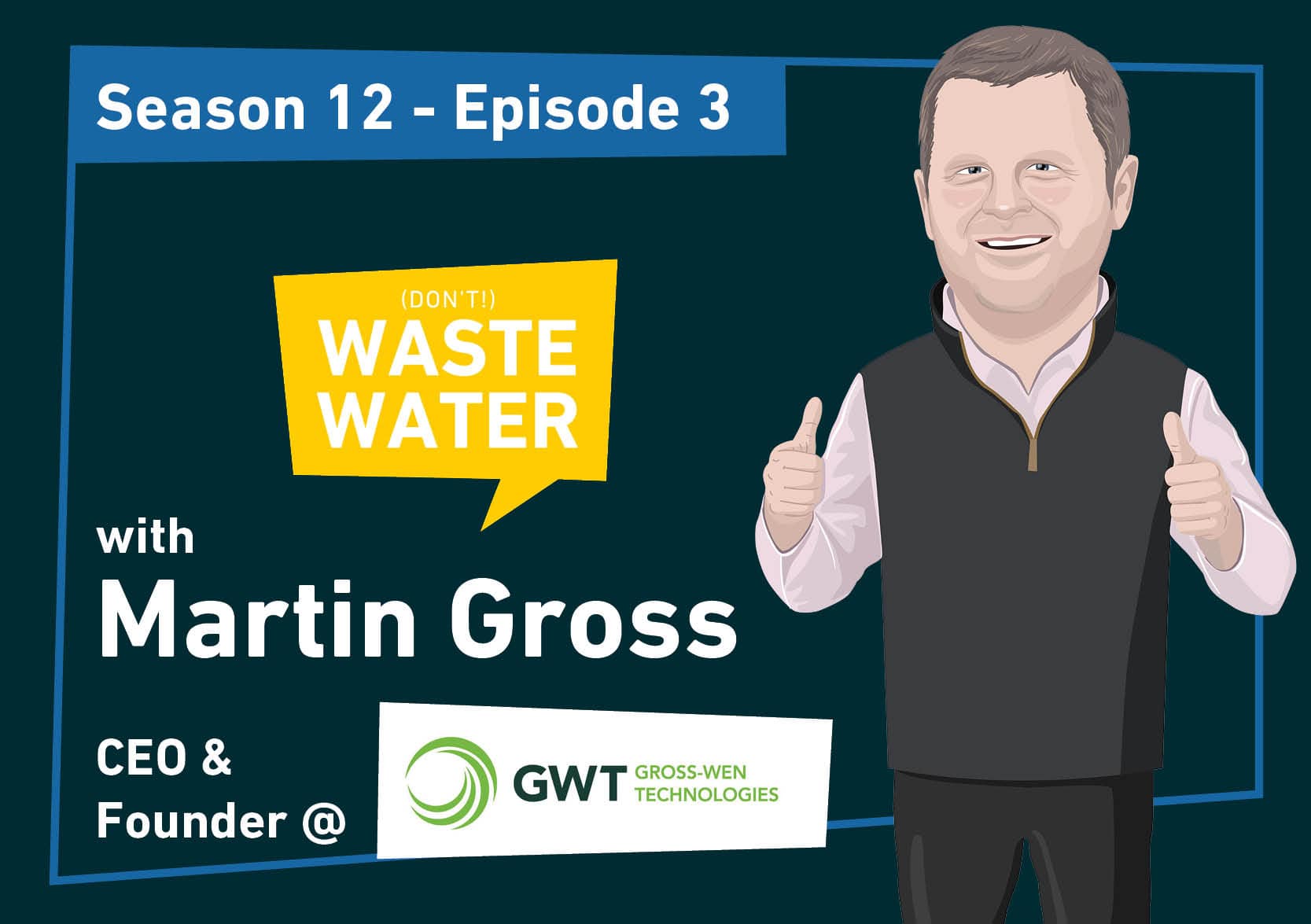
Martin Gross was a guest on the show once, walking through how Gross-Wen cleans wastewater with algae:
The company
Frequently asked
- Who is Martin Gross of Gross-Wen Technologies?
- Martin Gross is the CEO and co-founder of Gross-Wen Technologies, an Iowa wastewater company. He earned dual PhDs at Iowa State University and co-founded the company in 2014 with his advisor, Dr. Zhiyou Wen, to clean wastewater with algae instead of bacteria and chemicals.
- What does Gross-Wen Technologies do?
- Gross-Wen Technologies treats municipal and industrial wastewater using its patented Revolving Algal Biofilm (RAB) system: slowly rotating belts on which algae grow, recovering nitrogen and phosphorus from the water while absorbing CO2 from the air, at about a third of the energy of conventional bacterial treatment.
- How did Martin Gross start Gross-Wen Technologies?
- Martin Gross discovered algae in an Iowa State genetics class, then cold-emailed professor Zhiyou Wen on the man's third day on campus. His PhD, growing algae on rotating belts, became the company in 2016. The City of Chicago's interest pulled the technology from biofuels into wastewater treatment.
- How much funding has Gross-Wen Technologies raised?
- Gross-Wen Technologies raised a $6.5 million Series A in 2021, led by ISA Ventures, with a further round in 2025. The funding backs the commercial rollout of its algae-based RAB wastewater systems to municipal and industrial customers, particularly food and beverage processors.
- Which Martin Gross is this, and where can I hear him?
- This Martin Gross is the Iowa water-tech founder behind Gross-Wen Technologies, not the New Hampshire urologist or the German artist who share the name. He appeared on the (don't) Waste Water podcast in 2024 to explain carbon-negative, algae-based wastewater treatment; that episode is linked above to listen.