Jordan Grose
Executive Vice President at Ionic Solutions
Executive VP of Ionic Solutions, the Calgary company whose C-EDR desalination swaps the high pressure of reverse osmosis for an electric field, cutting energy by 60 to 90 percent.
Compiled by Antoine Walter - from insight gathered on and off his (don’t) Waste Water microphone!
Jordan Grose is the Executive Vice President of Ionic Solutions, the Calgary desalination company that takes the salt out of water without the high pressure of reverse osmosis. Ionic's C-EDR technology pulls salt out with an electric field at around 30 PSI instead of pumps at up to 1,800 PSI, which is where its 60 to 90 percent energy saving comes from, as of 2026.
Jordan Grose is not the inventor of Ionic Solutions' technology, and he is the first to tell you so. The company was founded in Calgary in 2009 by Barry Johnson and Azar Yazdanbod, and the original spark was Azar's, a geotechnical engineer who grew up in an arid part of Iran and spent years working with soils and clays before noticing that clay has a capacitive nature, meaning it can hold an electrical charge. He wondered whether that same charge-holding trick could be turned on salt water, and a decade of tinkering (the founders apparently started the very next day in a Home Depot parking lot, buying parts) turned that hunch into a working desalination chemistry.
Jordan Grose joined that effort as employee number three, and his job is the one most deep-tech companies underrate. A Calgary mechanical engineer by training, with a P.Eng. and an MBA from the Haskayne School of Business, he spent roughly seventeen years at the engineering firm Wood (and the smaller Beta Machinery Analysis it grew out of), where his whole career was commercializing new product lines inside a big company, from anti-vibration machinery to a regional expansion into South-East Asia. So when he describes his role at Ionic, it is refreshingly plain: taking a great idea and a great technology that is sitting at lab and benchtop scale and getting it out into the real world, which means product development, manufacturing scale-up and sales all at once. He calls it a jack-of-all-trades role, and for a startup trying to sell something genuinely unfamiliar, that is exactly the job that needs doing.
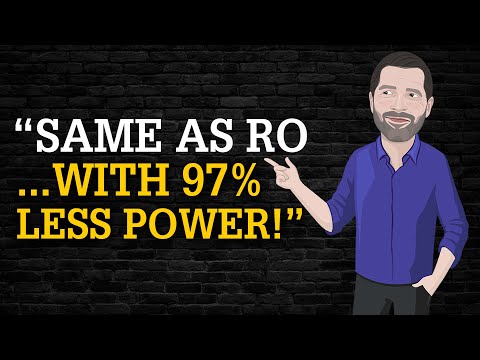
Ionic Solutions is worth a portrait because of what its technology actually does. Reverse osmosis, the desalination method the whole world runs on, works by pushing water molecules through a membrane under enormous pressure, somewhere between 600 and 1,800 PSI, while the salt stays behind. Ionic's C-EDR, short for Capacitive Electrodialysis Reversal, does almost the opposite: it runs the water through an electric field and pulls the salt ions across an ion-exchange membrane while the water stays put. Because nobody is pressurizing the water with high-pressure pumps, the system runs at roughly 30 PSI, and that is where the energy savings live. In Grose's own words, in most applications Ionic can desalinate for 60 to 90 percent less power than reverse osmosis, and in one low-salinity brackish case the company has presented a figure of 97 percent less, the kind of number it now takes to conferences like the International Water Conference to make people believe it.
Jordan Grose is candid that belief is genuinely the hard part. The market knows and loves reverse osmosis, and there is an older, weaker version of electrodialysis out there that cannot do what Ionic claims, so the company spends as much energy on education as on engineering. Its way in has been industrial customers with real pain, like a large New York City utility where Ionic treats the reject stream that ordinary reverse osmosis throws away. For every 100 gallons a minute of that reject it turns back into usable water, Grose says the utility saved about a quarter of a million dollars a year on its city water bills, which is the sort of arithmetic that gets a pilot signed. The same machine has a second life concentrating lithium brines (one pipe in, two pipes out, as he puts it, where the drinking-water people want one pipe and the lithium people want the other), and an unexpected champion has been the Electric Power Research Institute, which paid for early piloting and then opened doors across the power sector.
Jordan Grose frames all of this around what he calls the everyday Joe, which is a striking thing to hear from someone selling industrial hardware. His logic is that when a thirsty industry stops over-drawing the local supply, the saved water flows back to the people living around it, and he points out that the New York utility alone can use 20 to 30 percent of Manhattan's water at full tilt. So the mission he describes, increasing water security for ordinary people, is pursued one industrial reject stream at a time, and his bet is that a desalination that costs a fraction of the energy is the version that finally gets built at the scale the problem deserves. Ionic Solutions was named to the Foresight 50, Canada's list of its most investable cleantech ventures, which suggests the market is starting to agree.
“My role is kind of taking a great idea and a great technology that's in the lab stage, prototype, benchtop scale, and really getting it out into the marketplace in the real world.”
Grose is, in short, the translator a lab-born technology needs: the engineer-operator who can take a chemistry the founders spent a decade perfecting and turn it into a project a utility will actually buy.
On (don’t) Waste Water
Jordan Grose joined the show once, for a deep dive into how Ionic Solutions rethinks desalination:
The company
Frequently asked
- Who is Jordan Grose?
- Jordan Grose is the Executive Vice President of Ionic Solutions, a Calgary desalination company he joined as its third employee. A mechanical engineer with a P.Eng. and an MBA, he spent about seventeen years commercializing new product lines at the engineering firm Wood before taking on the job of getting Ionic's technology to market.
- What is Ionic Solutions, and what does it do?
- Ionic Solutions is a Calgary company, founded in 2009, that desalinates water with C-EDR (Capacitive Electrodialysis Reversal). Rather than push water through a membrane under high pressure like reverse osmosis, it pulls salt ions out with an electric field at low pressure, which it says cuts energy use by 60 to 90 percent.
- How is Ionic Solutions' C-EDR different from reverse osmosis?
- Reverse osmosis forces water through a membrane at 600 to 1,800 PSI while the salt stays behind. Ionic's C-EDR instead runs water through an electric field at around 30 PSI and pulls the salt across. With no high-pressure pumps, Jordan Grose says it uses 60 to 90 percent less power in most applications.
- What is Jordan Grose's role at Ionic Solutions?
- Jordan Grose leads commercialization at Ionic Solutions as Executive Vice President. He defines the job as taking a technology sitting at lab and benchtop scale and getting it into the real world, which spans product development, manufacturing scale-up and sales. He came on the (don’t) Waste Water podcast in 2024 to explain it.
- Where is Ionic Solutions based, and where can I hear Jordan Grose?
- Ionic Solutions is based in Calgary, Alberta, Canada, where it manufactures its C-EDR desalination cells. Jordan Grose was a guest on the (don’t) Waste Water podcast in 2024, on the episode "How Ionic Solutions Trades High Pressure for High Efficiency in Desalination," which is linked above to read, listen or watch.
- Is Jordan Grose the same as Ionic Solutions?
- No. Jordan Grose is a person, the Executive VP who runs commercialization at Ionic Solutions; Ionic Solutions is the Calgary company he works for, founded in 2009 by Barry Johnson and Azar Yazdanbod. Grose joined later as employee number three to take its C-EDR desalination technology to market.